RSS

How Commissions Work in Commercial Lease Transactions in British Columbia

A Practical Guide for Tenants, Landlords, and Investors


Commercial real estate leasing in British Columbia operates under a commission structure that is often misunderstood — particularly by tenants entering the market for the first time.

Unlike residential transactions, where commissions are more standardized, commercial lease commissions vary based on:

  • Deal structure

  • Lease term

  • Rent profile

  • Brokerage agreements

Understanding how commissions are structured helps all parties navigate leasing transactions with clarity and confidence.


1. Who Pays the Commission?

In most commercial lease transactions in BC:

👉 The landlord pays the commission

This commission is:

  • Paid to the listing brokerage

  • Then shared with the cooperating brokerage (if applicable)

Tenants typically:

  • Do not pay commissions directly

  • Benefit from broker representation at no out-of-pocket cost


2. How Commissions Are Calculated

Commercial leasing commissions are generally based on:

👉 Total lease value over the term

This includes:

  • Base rent

  • Sometimes additional rent (depending on the agreement)


Typical Structure (Simplified Example)

A common structure may look like:

  • Year 1–5: ~4%–6% of gross rent

  • Years 6–10: Lower percentage (e.g., 2%–3%)

👉 The longer the lease term, the larger the total commission — but at declining rates


3. What Is “Gross Lease Value”?

Gross lease value refers to:

👉 Total rent payable over the lease term

Example:

  • 2,000 sq. ft.

  • $20/sq.ft. base rent

  • 5-year lease

Annual rent = $40,000
Total lease value = $200,000

Commission is calculated on this amount.


4. How Commissions Are Split Between Brokers

When two brokerages are involved:

  • Listing agent (landlord rep)

  • Cooperating agent (tenant rep)

👉 The commission is typically split:

  • 50/50 or 60/40 (common, but not fixed)

This split is agreed upon in advance and disclosed.


5. What Happens in Renewal or Extension?

If a tenant renews:

  • The original agreement may include a renewal commission clause

  • Generally, no commissions are paid upon renewal or in some cases, a smaller commission may be payable on the extended term

👉 This depends on the original listing agreement


6. What About Off-Market or Direct Deals?

In off-market scenarios:

  • Commission terms are negotiated directly

  • May involve:

    • Lower total commission

    • Referral fees

    • Exclusive representation agreements

👉 These deals are more flexible but require clarity upfront


7. Why This Matters for Tenants

Even though tenants don’t pay commissions directly:

👉 Commissions are effectively built into the economics of the lease

Understanding this helps tenants:

  • Negotiate more effectively

  • Understand broker incentives

  • Structure stronger offers


8. Why This Matters for Landlords

For landlords:

  • Commission is a transaction cost

  • Influences:

    • Net effective rent

    • Deal structure

    • Lease term preferences

Landlords often:

  • Prefer longer lease terms

  • Structure deals to justify commission outlay


9. Transparency and Disclosure

In British Columbia, licensed real estate professionals are required to:

  • Disclose how they are compensated

  • Provide clarity on representation

  • Act in accordance with regulatory standards

👉 This ensures transparency for all parties involved

Licensed real estate professionals in British Columbia are regulated by the BC Financial Services Authority

✅ 1. BC Financial Services Authority (BCFSA)

👉 https://www.bcfsa.ca

Commission structures and disclosure obligations are governed by professional standards set by the Real Estate Council of BC

✅ 2. Real Estate Council of BC (Professional Standards)

👉 https://www.bcfsa.ca/industry-resources/real-estate

Industry practices are also shaped by broader guidelines from organizations such as the British Columbia Real Estate Association

✅ 3. BCREA

👉 https://www.bcrea.bc.ca


Conclusion

Commercial lease commissions in British Columbia are flexible, deal-driven, and based on the total value of the lease over time.

While landlords typically pay the commission, it remains an important factor influencing:

  • Deal structure

  • Lease terms

  • Negotiation dynamics

For tenants, landlords, and investors alike, understanding how commissions work leads to more informed decisions and smoother transactions.


Helpful Resources

👉 BC Financial Services Authority (BCFSA)

👉Real Estate Council of British Columbia – Professional Standards

👉British Columbia Real Estate Association (BCREA)


Frequently Asked Questions

Do tenants pay commission in commercial leases in BC?
No, in most cases the landlord pays the commission, which is shared between the listing and cooperating brokerages.

Is commission included in the rent?
Indirectly, yes. While tenants do not pay commissions upfront, it is typically factored into the overall lease economics.

Are commercial real estate commissions fixed in BC?
No, commissions are fully negotiable and vary based on lease term, deal structure, and market conditions.

How are commissions paid on long-term leases?
They are typically calculated on the total lease value, with higher percentages in earlier years and lower percentages on extended terms.

Do brokers get paid on lease renewals?
Sometimes. Renewal commissions depend on the original listing agreement and whether a renewal clause is included.

Can commission be negotiated in off-market deals?
Yes. Off-market transactions often involve more flexible and customized commission arrangements.

Why do landlords prefer longer lease terms?
Longer leases justify higher total commissions and provide more predictable income, making the asset more valuable and financeable.
Read

Business Licence vs. Use Approval: What Commercial Tenants Must Know Before Leasing Space in Nanaimo

Avoid Costly Mistakes by Understanding the Approval Process


One of the most common misunderstandings in commercial leasing is the difference between a business licence and approval for a specific use of a property.

Many tenants assume that once they secure a lease, they can simply apply for a business licence and begin operations. In reality, municipalities like Nanaimo require that your intended use is permitted under zoning and approved from a planning perspective before a business licence is issued.

Failing to understand this distinction can lead to:

  • Delays in opening

  • Unexpected costs

  • Lease commitments without approval

  • In some cases, being unable to operate at all

This guide explains the difference and outlines how to approach the process correctly.

1. What Is a Business Licence?

A business licence is a municipal authorization that allows you to legally operate a business within the city.

It confirms:

  • Your business is registered with the municipality

  • You meet basic operational and safety requirements

  • You are authorized to conduct business at a specific location

However, a business licence does not determine whether your use is allowed at that location.

👉 It is the final step, not the first.


2. What Is “Approval for Intended Use”?

Before applying for a business licence, the City must confirm that your intended use complies with zoning and building regulations.

This includes:

  • Whether your business type is permitted in that zone

  • Whether it is a permitted use or conditional use

  • Whether the building meets requirements for that use

This process may involve:

  • Planning department review

  • Zoning confirmation

  • Change of use or occupancy classification

  • Building permit requirements

👉 This is often referred to informally as:

  • “Zoning approval”

  • “Use approval”

  • “Occupancy compliance”


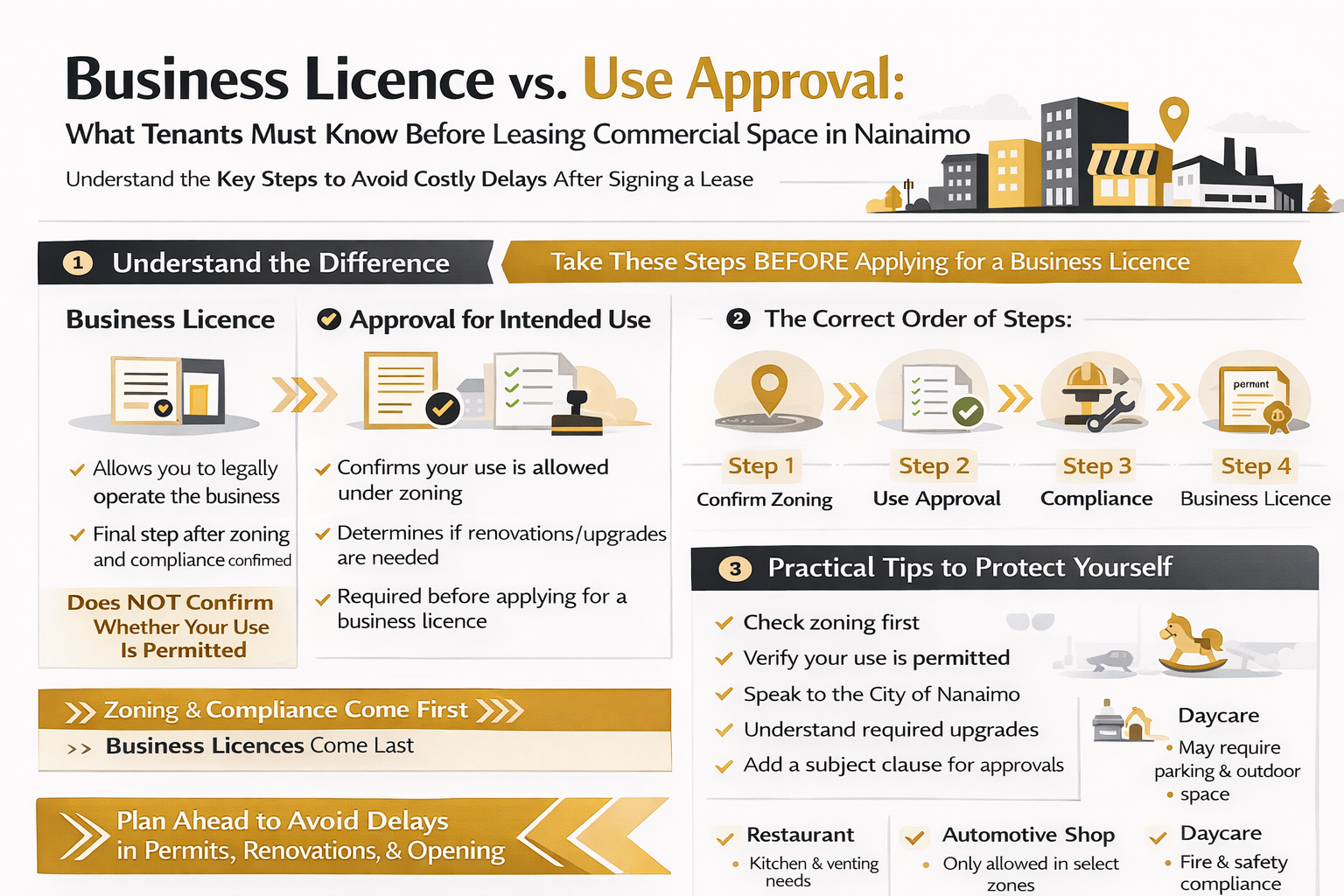
3. The Correct Order of Steps

Understanding the sequence is critical:

Step 1 — Confirm Zoning & Permitted Use

  • Is your business allowed in that zone?

  • Is it permitted or conditional?


Step 2 — Planning / Use Approval

  • City confirms your use is acceptable

  • May require additional review or conditions


Step 3 — Building & Code Compliance

  • Fire safety

  • Washrooms and accessibility

  • Ventilation (for restaurants, etc.)

  • Electrical or mechanical upgrades


Step 4 — Apply for Business Licence

  • Only after the above are satisfied


4. Real-World Examples (Nanaimo Context)

Example 1 — Daycare

  • Zoning may allow daycare conditionally

  • Requires:

    • Outdoor fenced space

    • Occupancy classification change

    • Safety approvals

👉 Business licence will not be issued until these are completed.


Example 2 — Restaurant

  • Zoning may permit restaurant use

  • But requires:

    • Commercial kitchen

    • Ventilation (hood system)

    • Fire suppression

    • Accessible washrooms

👉 Lease signed without checking = major risk


Example 3 — Automotive / Industrial Use

  • May only be permitted in specific zones (e.g., industrial)

  • Some commercial zones restrict or prohibit these uses


5. Why This Matters for Tenants

If you skip the approval process:

❌ You may lease a space you cannot use
❌ You may face unexpected renovation costs
❌ You may experience delays of weeks or months
❌ You may breach lease timelines

👉 This is one of the most common and costly mistakes in commercial leasing.


6. Why This Matters for Landlords

Landlords also need to be cautious:

  • Not all tenants are suitable for every unit

  • Incorrect use can create:

    • Compliance issues

    • Insurance risks

    • Neighbouring tenant conflicts

A well-informed leasing process:

  • Reduces vacancy risk

  • Improves tenant quality

  • Avoids future disputes


7. How to Protect Yourself (Practical Advice)

Before signing a lease:

✔ Confirm zoning designation
✔ Verify your use is permitted (or conditional)
✔ Speak with the City of Nanaimo planning department
✔ Understand required upgrades or improvements
✔ Include a subject clause for municipal approvals

👉 Example condition:

“Subject to the tenant obtaining all necessary municipal approvals, including zoning, use, and business licence.”


8. The Key Takeaway

A business licence allows you to operate.
But zoning and use approval determine whether you can.

Understanding this distinction is critical to:

  • Avoid risk

  • Save time and capital

  • Ensure a smooth and successful business launch


Conclusion

In Nanaimo’s competitive commercial market, the difference between a smooth opening and a costly delay often comes down to understanding the approval process.

By confirming zoning, securing use approval, and completing necessary compliance steps before applying for a business licence, tenants can move forward with confidence.

For both tenants and landlords, clarity at the outset leads to better outcomes and stronger long-term relationships.


Frequently Asked Questions

Do I need zoning approval before getting a business licence?
Yes, your intended use must comply with zoning regulations before a business licence is issued.

What happens if my business use is not permitted?
You may need to apply for a conditional use approval or find an alternative location.

How long does it take to get a business licence in Nanaimo?
Timelines vary depending on approvals required, but delays often occur if zoning or building compliance is not confirmed early.

Can I sign a lease before getting approvals?
Yes, but it is strongly recommended to include conditions subject to zoning and municipal approvals.


Helpful Resources

👉You can verify zoning designations using the City of Nanaimo Zoning Bylaw

👉You can verify zoning designations using the City’s interactive zoning map

👉Business Licence Information

👉BC Property Transfer Tax Guide

Read

Understanding Zoning in Nanaimo: A Practical Guide for Commercial Real Estate Investors and Business Owners

How Zoning Impacts What You Can (and Cannot) Do With a Property. 

Zoning is one of the most important — and often misunderstood — aspects of commercial real estate.


Whether you are:

  • Purchasing an investment property

  • Leasing space for a business

  • Exploring development opportunities

Zoning determines what uses are legally permitted on a property.

In markets like Nanaimo, where industrial and commercial supply is limited, understanding zoning is critical to:

  • Avoid costly mistakes

  • Structure deals correctly

  • Identify hidden opportunities

This guide provides a practical overview of how zoning works in Nanaimo and what investors and tenants need to consider.

1. What Is Zoning?

Zoning is a regulatory framework used by municipalities to control how land and buildings can be used.

Each property is assigned a specific zoning designation, which defines:

  • Permitted uses (what you can do)

  • Conditional uses (what may be allowed with approval)

  • Restrictions (what you cannot do)

  • Building requirements (height, setbacks, density)

Zoning ensures:

  • Orderly development

  • Compatibility between neighbouring uses

  • Protection of infrastructure and community planning


2. Common Commercial & Industrial Zoning Categories in Nanaimo

While exact definitions vary, the most relevant zoning categories include:

Industrial (I Zones)

Examples: I1, I2, I3

Typical uses:

  • Warehousing

  • Light manufacturing

  • Trades and contractors

  • Outdoor storage (in certain zones)

  • Logistics and distribution

👉 These are the most in-demand zones due to limited supply.


Commercial (COR, CC, DT Zones)

COR (Corridor Commercial)

  • Retail, service businesses, restaurants

  • Some automotive and service uses

  • High visibility locations (e.g., Bowen Rd)

CC (Community Commercial)

  • Shopping centres

  • Grocery-anchored retail

  • Service businesses

DT (Downtown Zones)

  • Retail, office, restaurants

  • Mixed-use (commercial + residential)

  • Higher density and pedestrian-oriented


Mixed-Use Zones

  • Combine residential and commercial uses

  • Increasingly common in redevelopment areas


3. Permitted vs Conditional Uses (Critical Concept)

Every zoning category has two key classifications:

Permitted Uses

✔ Allowed “as-of-right”
✔ No additional approvals required (beyond permits)

Example:

  • Warehouse in an industrial zone


Conditional Uses

⚠ Allowed only with municipal approval

May require:

  • Additional review

  • Public consultation

  • Specific conditions

Example:

  • Daycare in certain commercial zones

  • Automotive use in select areas


Why This Matters

A property may technically allow your use — but only conditionally.

👉 This can impact:

  • Timelines

  • Risk

  • Financing

  • Lease negotiations


4. Zoning Is Only One Piece — You Still Need Approvals

Even if zoning permits your use, you may still need:

  • Business licence approval

  • Building permits

  • Fire and safety compliance

  • Health authority approvals (for food, daycare, etc.)

Example:
A restaurant may be allowed under zoning, but still requires:

  • Commercial kitchen ventilation

  • Washroom compliance

  • Fire suppression systems

👉 Zoning ≠ automatic approval


5. Why Zoning Matters for Investors

For investors, zoning directly impacts:

1. Income Potential

  • Broader permitted uses = larger tenant pool

  • More demand = stronger rents

2. Liquidity

  • Flexible zoning = easier resale

3. Risk

  • Restrictive zoning = longer vacancy periods

4. Future Upside

  • Rezoning potential = redevelopment value


6. Zoning as a Strategy (Where the Real Opportunity Lies)

Sophisticated investors don’t just accept zoning — they use it strategically.

Examples:

✔ Buying underutilized land with rezoning potential
✔ Identifying properties with rare permitted uses
✔ Securing industrial-zoned land in supply-constrained areas
✔ Leasing to tenants whose use fits perfectly within zoning (low risk)

In markets like Nanaimo:

Zoning constraints = opportunity for those who understand them


7. Common Mistakes to Avoid

❌ Assuming a use is allowed without verification
❌ Not checking conditional use requirements
❌ Ignoring parking or servicing requirements
❌ Overlooking environmental or drainage constraints
❌ Signing leases before confirming approvals

👉 These mistakes can delay projects or kill deals entirely.


8. How to Verify Zoning (Practical Steps)

Before committing to a property:

  1. Confirm zoning designation

  2. Review permitted and conditional uses

  3. Speak with City of Nanaimo planning department

  4. Verify any site-specific restrictions

  5. Confirm required approvals for your use


Conclusion

Zoning is a foundational element of commercial real estate — it determines what is possible, what is profitable, and what is risky.

In a supply-constrained market like Nanaimo:

  • The right zoning can unlock long-term value

  • The wrong zoning can limit flexibility and income

For investors and business owners alike, understanding zoning is not optional — it is a critical part of making informed, disciplined real estate decisions.


Frequently Asked Questions

How do I check zoning for a property in Nanaimo?
Zoning can be verified through the City of Nanaimo’s zoning bylaw and interactive mapping tools.

What is the difference between permitted and conditional use?
Permitted uses are allowed as-of-right, while conditional uses require additional municipal approval.

Can zoning be changed or rezoned?
Yes, but rezoning requires a formal application process and approval from the municipality.

Why is zoning important for commercial real estate?
Zoning determines what type of business or development is allowed on a property, directly impacting its value and usability.


Helpful Resources

👉You can verify zoning designations using the City of Nanaimo Zoning Bylaw

👉You can verify zoning designations using the City’s interactive zoning map

👉Business Licence Information

👉BC Property Transfer Tax Guide

Read

Understanding Canadian Lease Structures: NNN, Gross, and CAM Charges Explained

For many international investors — especially those from the UK and Europe — commercial leasing terminology in Canada can appear unfamiliar. Terms such as NNN, net lease, additional rent, and CAM charges are commonly used in Canadian commercial property contracts, and understanding these concepts is essential for evaluating cash flow and risk.

This article provides a clear, structured overview of the main lease structures in Canada and how they affect investment performance. The examples are broadly applicable across the country but especially relevant to Vancouver Island’s industrial, retail, and service-commercial markets.

1. The Three Primary Lease Structures in Canada

Commercial leases in Canada typically fall into one of three categories:

  1. Triple Net (NNN) Lease

  2. Net Lease (Semi-Net) or Modified Net Lease

  3. Gross or Fully Gross Lease

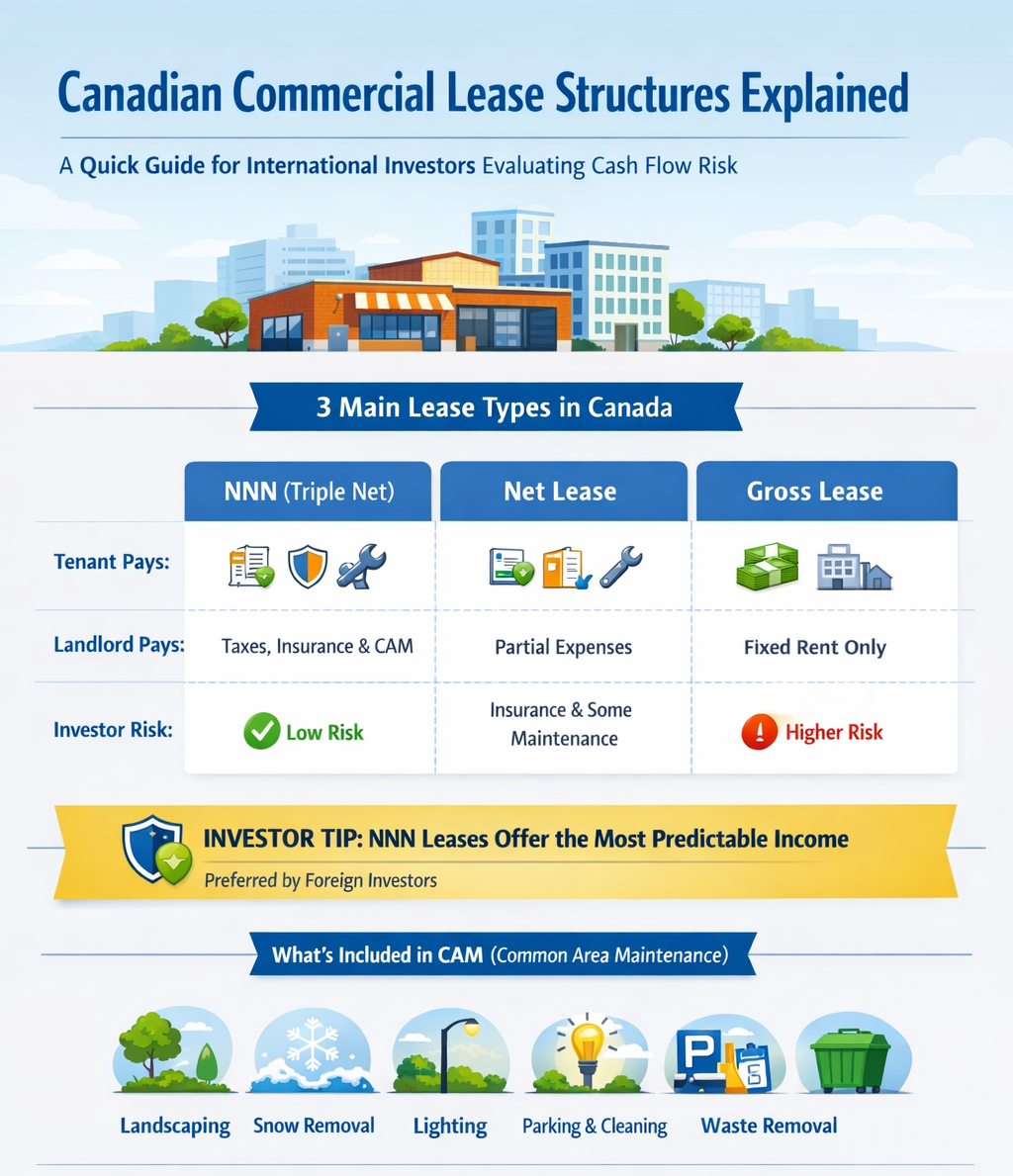
This infographic explains the key commercial lease structures in Canada—NNN, net, and gross—and how they impact operating costs, risk, and net operating income. By clarifying concepts such as additional rent and CAM charges, it helps investors and business owners better understand cash flow dynamics and make more informed real estate decisions.

These structures determine how operating expenses, taxes, insurance, and maintenance costs are allocated between landlord and tenant — and therefore impact the property’s Net Operating Income (NOI) and risk profile.


2. Triple Net (NNN) Lease

Most Common Form for Industrial & Retail on Vancouver Island

A Triple Net Lease is the dominant structure for industrial and service-commercial properties.

Under an NNN lease, the tenant pays:

  • Property taxes

  • Building insurance

  • Common area maintenance (CAM)

  • Utilities (depending on metering)

  • Base rent

The landlord typically pays:

  • Structural repairs

  • Roof (depending on the lease)

  • Building envelope

  • Capital improvements

Why investors prefer NNN leases:

  • Highly predictable cash flow

  • Lower operating expense variability

  • Operating costs are passed through to the tenant

  • NOI is stable across inflationary environments

  • Minimal landlord involvement in day-to-day operations

Example on Vancouver Island:

A trades or logistics tenant occupying a small-bay industrial unit typically pays:

  • Base rent (e.g., $16/sq.ft.)

  • Additional rent (NNN) (e.g., $8–$12/sq.ft.)

This structure is ideal for overseas investors due to its simplicity and income transparency.


3. Net Lease (Modified Net or Semi-Net Lease)

Shared Responsibilities, Often Used in Older Assets

In a Net Lease, the tenant pays some — but not all — operating expenses. The division of responsibilities varies by contract.

A typical Modified Net lease may involve:

  • Tenant pays: property taxes + utilities

  • Landlord pays: building insurance, some maintenance, structural repairs

Investor considerations:

  • NOI may have slightly higher volatility

  • Lease clarity in the contract is essential

  • Operating expenses should be underwritten conservatively

These leases often appear in older industrial buildings or certain retail properties where the landlord retains more responsibility.


4. Gross and Fully Gross Leases

Tenant Pays One Fixed Amount; Landlord Covers Most or All Operating Costs

A Gross Lease means the tenant pays a single fixed rental amount, and the landlord pays:

  • Property taxes

  • Insurance

  • Maintenance

  • Common area costs

  • Utilities (sometimes)

Implications for investors:

  • NOI is more sensitive to increases in operating expenses

  • Inflation or property tax increases reduce margin

  • Strong expense controls are essential

  • Rent escalations must account for rising costs

Gross leases are more common in:

  • Office environments

  • Smaller retail spaces

  • Properties where the landlord manages more operational aspects

For international investors, gross leases require deeper underwriting due to their expense sensitivity.


5. Understanding CAM (Common Area Maintenance) Charges

CAM charges are a key component of additional rent under NNN and Net leases.
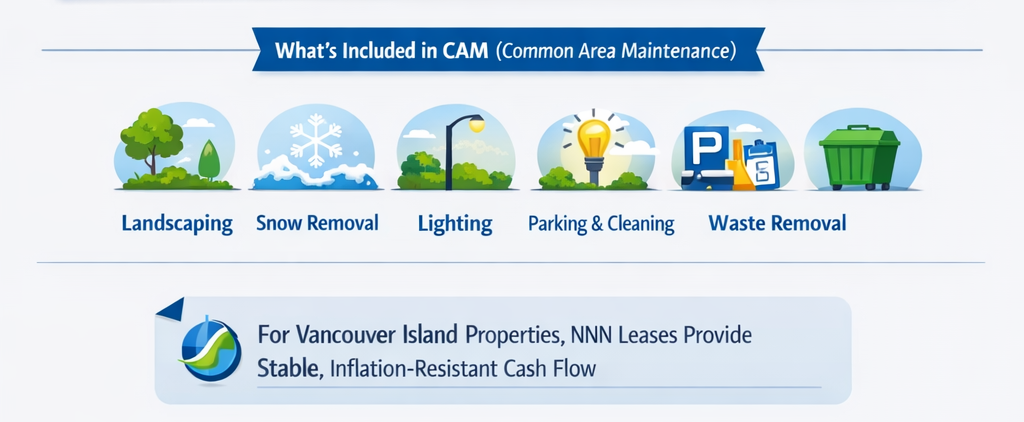
They typically include:

  • Landscaping

  • Parking lot maintenance

  • Lighting

  • Waste removal

  • Snow removal

  • Common area cleaning

  • Repairs to shared areas

  • Property management costs

CAM is typically reconciled annually, meaning tenants may receive a credit or debit depending on actual vs. estimated costs.

Why CAM matters for investors:

  • Clear CAM provisions protect NOI

  • Ambiguity can create disputes or unexpected costs

  • High-quality leases detail CAM inclusions and exclusions

A well-written CAM clause supports predictable, low-friction landlord–tenant relationships.


6. Additional Rent: A Canadian Leasing Term Every Investor Should Know

In Canada, additional rent is a collective term used in net leases to describe:

  • NNN charges

  • CAM fees

  • Property taxes

  • Insurance costs

  • Any other operating expenses passed through to tenants

This is similar to service charges in the UK, but typically more comprehensive.

Understanding additional rent is essential for accurate underwriting and cash flow modelling.


7. Which Lease Structure Is Best for Overseas Investors?

For international buyers who prefer predictable income and lower management burden:

Triple Net (NNN) leases are generally the most suitable.

They provide:

  • Stable NOI

  • Lower volatility

  • Minimal landlord involvement

  • Clear allocation of expenses

  • Natural inflation protection (through pass-through expenses and escalations)

NNN leases are particularly common in Vancouver Island’s industrial and service-commercial sectors — making them ideal for foreign investors seeking simplicity and stability.


Conclusion

Understanding Canadian lease structures is a key part of evaluating commercial real estate. Whether the property is leased under an NNN, Net, or Gross agreement, the clarity of the lease contract and the alignment of responsibilities between landlord and tenant significantly impact investment performance.

For overseas investors, NNN leases provide the most predictable and low-maintenance cash flow, which aligns well with long-distance ownership.
Gross and Net leases require deeper underwriting but can offer attractive opportunities when priced appropriately.

With disciplined analysis and the right advisory support, international investors can navigate Canadian lease structures with confidence.


Frequently Asked Questions

What is a triple net (NNN) lease?
A lease where the tenant pays base rent plus operating costs, including property taxes, insurance, and maintenance.

What is the difference between gross and net leases?
In a gross lease, the landlord pays most expenses, while in net leases, tenants pay some or all operating costs.

What are CAM charges?
Common Area Maintenance (CAM) charges include shared property expenses such as landscaping, lighting, and cleaning.

Which lease structure is best for investors?
NNN leases are generally preferred due to stable and predictable income.

Read
MLS® property information is provided under copyright© by the Vancouver Island Real Estate Board and Victoria Real Estate Board. The information is from sources deemed reliable, but should not be relied upon without independent verification.