Strong Demand, But Limited Landlord Acceptance
Despite strong demand from vape and smoke shop operators in Nanaimo, securing suitable commercial space has become increasingly difficult.
In many cases, tenants are:
Offering above-market rents
Ready to sign quickly
Seeking long-term leases
Yet, landlords remain hesitant — and often decline these tenants altogether.
This disconnect highlights a broader reality in the commercial leasing market:
Not all demand is equal from a landlord’s perspective.
1. Tenant Demand Is Real — and Growing
Vape and smoke shop operators are actively seeking space across:
Corridor commercial locations
Downtown retail units
High-visibility storefronts
From a purely financial standpoint:
Many are well-capitalized
Willing to pay premium rents
Looking for immediate occupancy
👉 On paper, they appear to be ideal tenants.
2. Landlord Concerns Go Beyond Rent
However, landlords are not evaluating tenants based on rent alone.
Key concerns include:
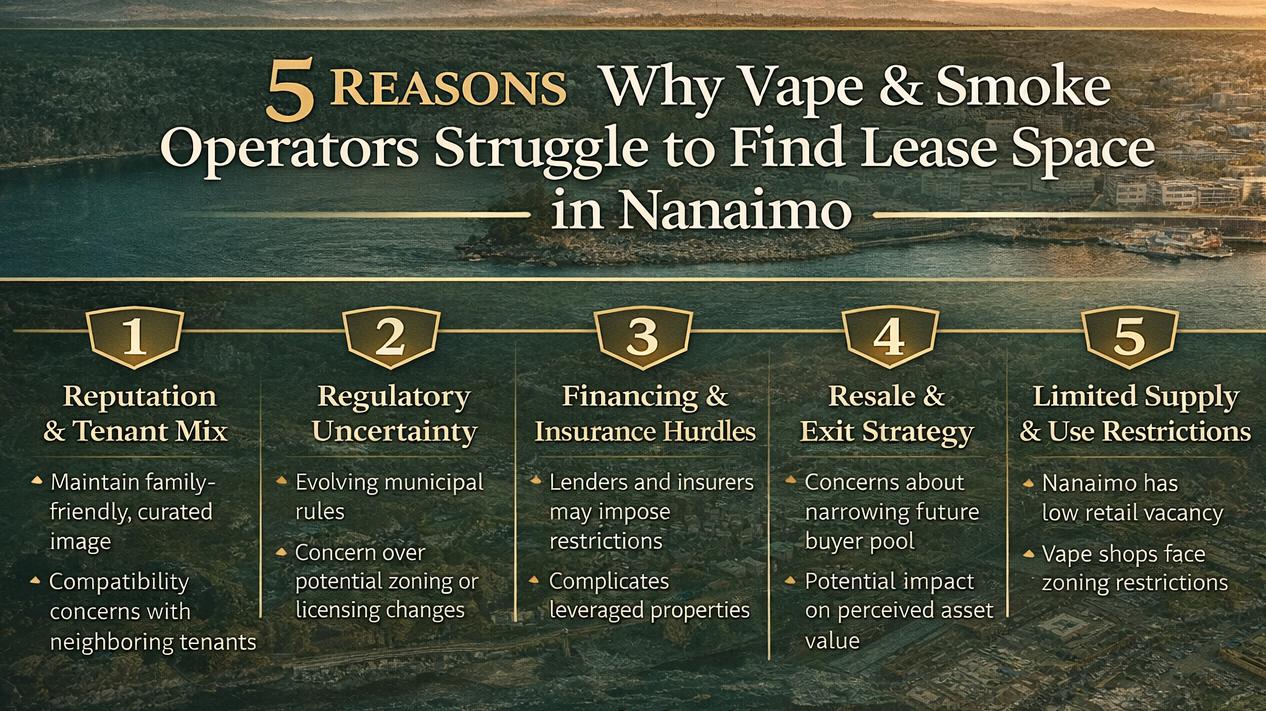
Reputation & Tenant Mix
Many landlords are focused on maintaining:
A family-friendly image
A curated tenant mix
Compatibility with neighbouring businesses
Vape and smoke-related uses are sometimes viewed as:
Misaligned with the property’s positioning
Undesirable for adjacent tenants (e.g., medical, professional, or family-oriented uses)
Regulatory Uncertainty
Municipal regulations around vape and smoke shops continue to evolve.
Landlords may be concerned about:
Zoning restrictions
Future regulatory tightening
Licensing complexities
👉 This creates perceived long-term risk
Financing & Insurance Considerations
Some lenders and insurers may:
View these uses as higher risk
Impose additional conditions
This can influence landlord decision-making, especially for:
Leveraged properties
Institutional ownership
Resale & Exit Strategy
Landlords also think about:
Future buyers
Marketability of the asset
A lease to a vape or smoke operator may:
Narrow the future buyer pool
Impact perceived property value
3. Limited Supply Amplifies the Challenge
Nanaimo already faces:
Limited retail inventory
Strong demand from multiple tenant categories
This means landlords often have multiple tenant options, including:
Service-based businesses
Medical or professional users
Food and beverage operators
👉 When given a choice, many landlords prioritize:
stability + compatibility over rent maximization
4. Zoning and Use Restrictions Play a Role
In certain zones:
Vape and smoke-related uses may be restricted or conditional
Additional approvals may be required
This introduces:
Delays
Uncertainty
Additional work for landlords
👉 Many prefer to avoid this altogether.
5. What This Means for Operators
For vape and smoke shop tenants, this market dynamic means:
Longer Search Timelines
Securing space may take significantly longer than other retail uses.
Need for Targeted Strategy
Success often depends on:
Identifying landlord profiles more open to the use
Focusing on specific zones or properties
Working with brokers familiar with local dynamics
Flexibility Is Key
Operators may need to:
Consider secondary locations
Explore less competitive submarkets
Be flexible on size and layout
Conclusion
The difficulty faced by vape and smoke shop operators in Nanaimo is not due to lack of demand — but rather a mismatch between tenant demand and landlord preferences.
While these tenants may offer strong financial terms, landlords continue to prioritize:
Tenant mix
Long-term asset value
Regulatory clarity
Compatibility with surrounding uses
Understanding these dynamics is essential for navigating the leasing market effectively.
Frequently Asked Questions
Why are vape and smoke shops struggling to find space in Nanaimo?
Landlords often prioritize tenant mix, building reputation, and long-term asset value over higher rental offers.
Are vape shops allowed in all commercial zones?
No, zoning restrictions and conditional use requirements may limit where these businesses can operate.
Do landlords reject vape tenants even if they offer higher rent?
Yes, many landlords consider factors beyond rent, including neighbouring tenants and property positioning.
What can vape operators do to improve their chances of leasing space?
Working with a broker, targeting suitable zones, and being flexible with location and layout can improve success.
Helpful Resources
Navigating zoning and licensing requirements is a critical step for vape and smoke shop operators. Reviewing municipal regulations and confirming permitted uses early in the process can help avoid delays and uncertainty.