Why Industrial Real Estate in Nanaimo Is Attracting Serious Investor Attention

A Strategic Perspective on Supply Constraints, Demand Drivers, and Long-Term Value
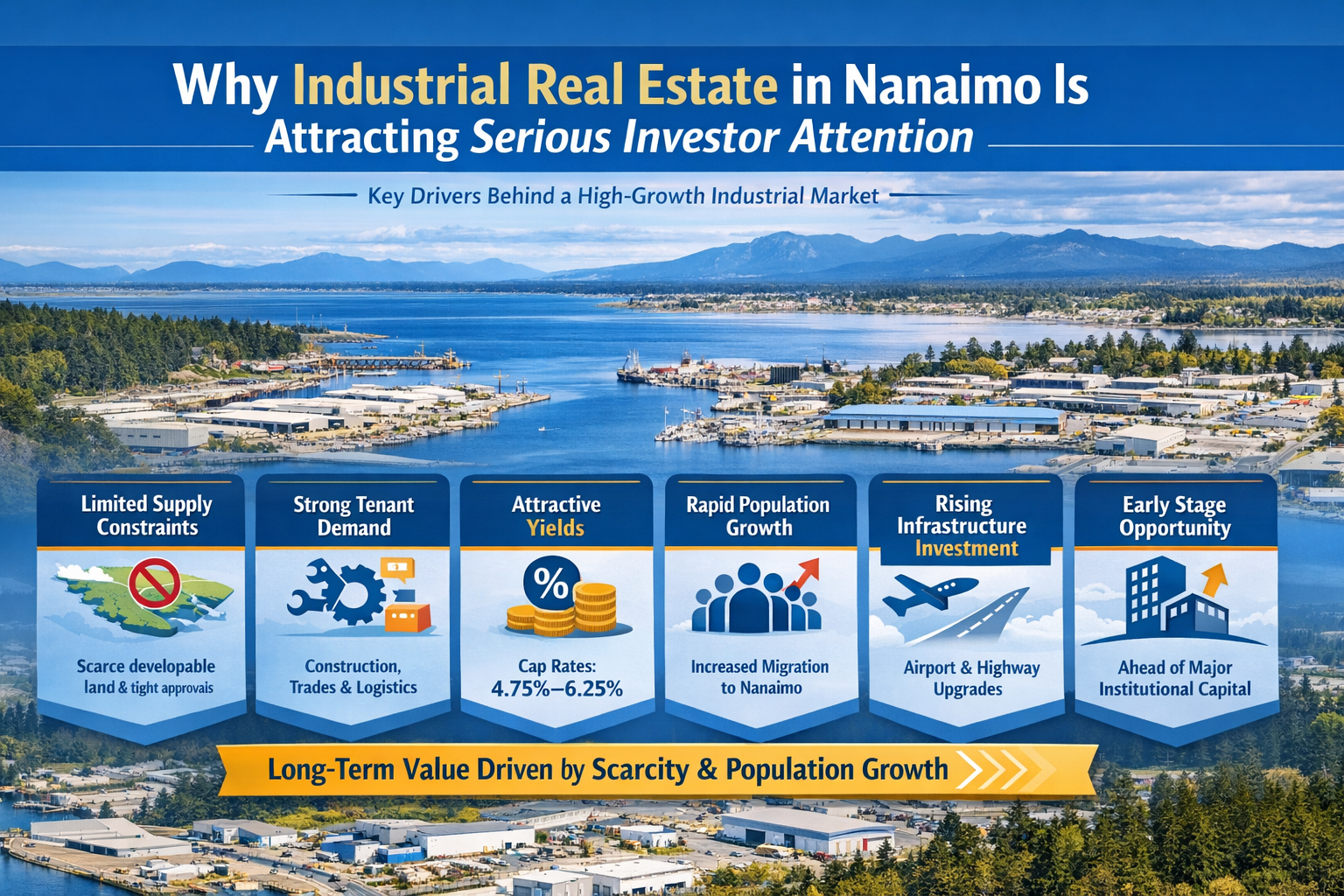

Industrial real estate across Canada has emerged as one of the most resilient asset classes over the past decade. While major markets such as Vancouver and Toronto have seen significant price appreciation and yield compression, smaller regional markets are increasingly drawing investor attention.

Nanaimo, located on Vancouver Island, is one such market. With strong population growth, constrained industrial land supply, and increasing demand from essential service industries, Nanaimo is beginning to exhibit characteristics typically associated with early-stage, high-growth industrial markets.

This article outlines the structural factors driving interest in Nanaimo’s industrial sector and why investors are increasingly allocating capital to the region.


1. Structural Supply Constraints Limit New Industrial Development

One of the defining characteristics of Nanaimo’s industrial market is limited land availability.

Several structural factors restrict new supply:

  • Island geography limits expansion

  • Agricultural Land Reserve (ALR) protections reduce developable land

  • Limited serviced industrial inventory

  • Lengthy zoning and approval processes

  • Competing demand from residential and mixed-use development

Unlike larger mainland markets, supply cannot easily respond to increased demand. This creates a structural imbalance that supports:

  • Long-term land value appreciation

  • Downside protection during economic cycles

  • Strong pricing power for landlords

For investors, constrained supply is one of the most important drivers of durable value.


2. Strong and Diverse Tenant Demand

Nanaimo’s industrial demand is driven by essential, non-discretionary sectors, including:

  • Construction and trades

  • Marine services

  • Equipment and logistics operators

  • Light manufacturing

  • Automotive and service-commercial users

These businesses are:

  • Locally embedded

  • Operationally necessary

  • Less sensitive to economic volatility

This results in:

  • High occupancy levels

  • Strong tenant retention

  • Lower default risk compared to office or discretionary retail

From an investment perspective, this tenant profile supports stable and predictable income streams.


3. Small-Bay Industrial Is in Particularly High Demand

A notable feature of Nanaimo’s market is the scarcity of small-bay industrial units.

These spaces are highly sought after by:

  • Local trades businesses

  • Contractors

  • Service operators

  • Owner-users

Key characteristics:

  • Units typically range from 1,000–5,000 sq. ft.

  • Limited new supply entering the market

  • High competition among tenants and buyers

As a result:

  • Vacancy rates remain extremely low

  • Lease rates have shown consistent upward pressure

  • Owner-user demand often competes directly with investors

This segment represents one of the most active and competitive areas within the local industrial market.


4. Attractive Risk-Adjusted Yields Compared to Major Markets

While yields in core markets have compressed significantly, Nanaimo continues to offer:

  • Industrial cap rates in the range of 4.75%–6.25%

  • Lower entry pricing compared to Greater Vancouver

  • Less institutional competition

Importantly, these returns are supported by:

  • Stable tenant demand

  • Long-term lease structures

  • Inflation-linked rent adjustments

For investors seeking a balance of income, stability, and growth, Nanaimo provides a compelling alternative to more saturated markets.


5. Population Growth Is Driving Long-Term Commercial Demand

Nanaimo is one of the fastest-growing mid-sized cities in British Columbia.

Key drivers include:

  • Migration from Greater Vancouver

  • Interprovincial migration

  • Growth in remote work

  • Lifestyle-driven relocation

Population growth directly impacts industrial demand through:

  • Increased need for local services

  • Expansion of trades and construction activity

  • Growth in logistics and distribution

Over time, these trends support:

  • Higher absorption of industrial space

  • Increased rental demand

  • Sustained pressure on limited supply


6. Infrastructure Investment Is Strengthening the Market

Infrastructure expansion plays a critical role in long-term real estate performance.

Nanaimo is currently benefiting from:

  • Airport expansion (YCD)

  • Highway and corridor upgrades

  • Growth in port and marine activity

  • Expansion of commercial nodes in North and South Nanaimo

Improved infrastructure enhances:

  • Connectivity

  • Business activity

  • Regional economic integration

Historically, these investments tend to precede sustained commercial growth cycles.


7. A Market in the Early Stages of Institutional Recognition

Markets such as Kelowna and Victoria have already undergone significant institutional investment cycles.

Nanaimo, by contrast, is:

  • Earlier in its growth trajectory

  • Less saturated by institutional capital

  • Still accessible to private and international investors

This creates an opportunity to:

  • Acquire assets at relatively favourable pricing

  • Benefit from future yield compression

  • Participate in long-term market maturation

In many ways, Nanaimo today resembles where other successful regional markets were 10–15 years ago.


Conclusion

Nanaimo’s industrial real estate market is supported by a combination of:

  • Structural supply constraints

  • Strong and diversified tenant demand

  • Attractive risk-adjusted yields

  • Sustained population growth

  • Ongoing infrastructure investment

Together, these factors create a stable and forward-looking investment environment.

For investors seeking long-term income, capital preservation, and exposure to a growing regional market, Nanaimo represents a compelling opportunity within Canada’s commercial real estate landscape.


Frequently Asked Questions

What types of industrial properties are available in Nanaimo?
Nanaimo offers a mix of small-bay industrial units, warehouse space, service-commercial buildings, and limited industrial land opportunities.

What are typical industrial cap rates in Nanaimo?
Industrial cap rates generally range between 4.75% and 6.25%, depending on tenant quality, lease terms, and location.

Why is industrial land scarce in Nanaimo?
Supply is constrained due to island geography, Agricultural Land Reserve (ALR) restrictions, and limited serviced industrial zoning.

Is Nanaimo a good market for industrial investment?
Yes, strong population growth, low vacancy, and limited supply make Nanaimo an attractive long-term industrial market.

Read

Why Nanaimo Is Emerging as the Next Victoria: A 10–15 Year Comparative Outlook

Understanding the Growth Patterns, Fundamentals, and Investment Signals

This infographic examines the parallels between Nanaimo’s current growth trajectory and Victoria’s evolution over the past decade, highlighting key drivers such as population expansion, infrastructure investment, and increasing commercial demand. As Nanaimo continues to mature into a regional economic hub, it presents a compelling opportunity for investors seeking early entry into a market with strong long-term growth potential.

Over the last decade, Victoria has transformed from a stable government-and-tourism-driven city into one of the most dynamic mid-sized economies in Canada. Its industrial and commercial markets have experienced significant appreciation, driven by population inflows, constrained land supply, municipal development initiatives, and the rise of knowledge-based industries.

Increasingly, investors are recognizing that Nanaimo today resembles Victoria 10–15 years ago — not only in growth trajectory, but also in demographic, economic, and infrastructural patterns. With rapid expansion, improved connectivity, and strong regional positioning, Nanaimo is becoming the island’s next major commercial hub.

This article outlines the structural parallels between the two cities and explains why Nanaimo is poised to follow a similar long-term growth path.


1. Population Growth Trends: Nanaimo Today Mirrors Victoria a Decade Ago

Victoria (10–15 years ago)

  • Began experiencing above-average population growth

  • Strong migration from Greater Vancouver and other provinces

  • Increasing inflow of young professionals

  • Lifestyle-driven relocation and retirement trends

Nanaimo (Today)

  • One of the fastest-growing mid-sized cities in Canada

  • Strong interprovincial migration

  • Attracting young families, remote workers, and trades professionals

  • Significant expansion in suburban areas and the regional district

Key Insight:
Nanaimo’s demographic profile closely mirrors Victoria’s pre-boom period — a foundational signal for long-term commercial and industrial demand.


2. Land Scarcity Dynamics: A Repeat of Victoria’s Supply Constraints

Victoria (10–15 years ago)

  • Limited industrial land due to geography and zoning

  • Aging industrial parks with little new supply

  • Rising pressure from residential developers

  • Sharp increase in industrial rents and land values

Nanaimo (Today)

  • Similar geographic constraints with mountains, water boundaries, and ALR

  • Limited industrial land inventory and few large parcels

  • Strong competing pressures for mixed-use and residential development

  • Industrial rental growth accelerating faster than supply

Key Insight:
Victoria’s industrial scarcity drove long-term asset appreciation.
Nanaimo’s land constraints position it for similar upward pressure over the next decade.


3. Infrastructure Investment: Nanaimo Is Entering Its Expansion Phase

Victoria (10–15 years ago)

  • Major upgrades to transportation and municipal infrastructure

  • Expansion of tech and innovation districts

  • Growth in academic institutions (e.g., UVic’s larger role)

Nanaimo (Today)

Significant infrastructural improvements are underway or recently completed:

  • Highway upgrades and improved corridor connectivity

  • Port expansion and increased marine industry activity

  • Nanaimo Airport (YCD) upgrades and expanded flight routes

  • Rapid growth around Woodgrove, North Nanaimo, South Nanaimo

  • Strengthening regional retail and service hubs

These investments typically precede commercial absorption, just as they did in Victoria.


4. Economic Diversification: Nanaimo’s Growth Curve Is Following Victoria’s Lead

Victoria (10–15 years ago)

Evolved from a government-dominated economy to include:

  • Tech and innovation

  • Education

  • Health care expansion

  • Professional services

  • Construction and trades

Nanaimo (Today)

Now experiencing similar diversification:

  • Expanding construction and trades ecosystem

  • Marine and logistics sector growth

  • Strengthening healthcare and education presence

  • Increased small-business formation

  • Emerging interest from tech, remote workers, and service industries

Key Insight:
Economic diversification was a pivotal turning point for Victoria — and Nanaimo is following the same pattern.


5. Commercial and Industrial Demand: Echoes of Victoria’s Earlier Cycle

Victoria (10–15 years ago)

  • Industrial vacancy fell below 2%

  • Owner-users began purchasing assets aggressively

  • Rents increased as supply dried up

  • Land values rose sharply

  • Small-bay industrial became one of the strongest-performing asset classes

Nanaimo (Today)

  • Small-bay industrial is already in high demand

  • Vacancy remains extremely low

  • Owner-users and trades are competing for limited supply

  • Industrial strata launching at higher rent expectations each year

  • Land values showing consistent upward pressure

Key Insight:
These indicators match Victoria’s early-cycle signals almost exactly — suggesting sustained performance ahead.


6. Location as a Regional Hub: Nanaimo’s Natural Advantage

Victoria’s Regional Role

Served as a South Island hub, drawing commuters and businesses from surrounding communities.

Nanaimo’s Positioning Today

  • The geographic centre of Vancouver Island

  • Ideal distribution point for north-south corridors

  • Serves as a regional retail and services hub

  • Ferry connections to the mainland strengthen logistics capability

  • Attracts users priced out of Greater Vancouver industrial markets

Nanaimo is now becoming the central commercial and industrial nexus that links North Vancouver Island, the Cowichan Valley, and the mid-Island region.


7. Investor Sentiment: Early-Stage Accumulation Phase

Victoria (10–15 years ago)

Sophisticated investors entered early, recognizing long-term structural advantages.

Nanaimo (Today)

Private investors, owner-users, and selective institutions are beginning to:

  • Acquire industrial strata units

  • Buy and hold service-commercial land

  • Pursue redevelopment opportunities

  • Enter long-term land-banking strategies

These moves mirror early investor behaviour seen in Victoria’s pre-growth phase.


Conclusion

Nanaimo exhibits many of the same characteristics that fueled Victoria’s transformation over the past decade: population growth, land scarcity, diversified economic expansion, infrastructure investment, and increasing commercial and industrial demand.

While the city is earlier in its growth cycle compared to Victoria, the parallels are clear — and compelling. For investors seeking long-term stability and strategic positioning in Western Canada, Nanaimo represents a rising market with strong fundamentals and an upward trajectory.


Helpful Resources

👉BC Stats (migration + population)

👉City of Nanaimo Official Community Plan (OCP)

👉 Economic statistics, BC

Read

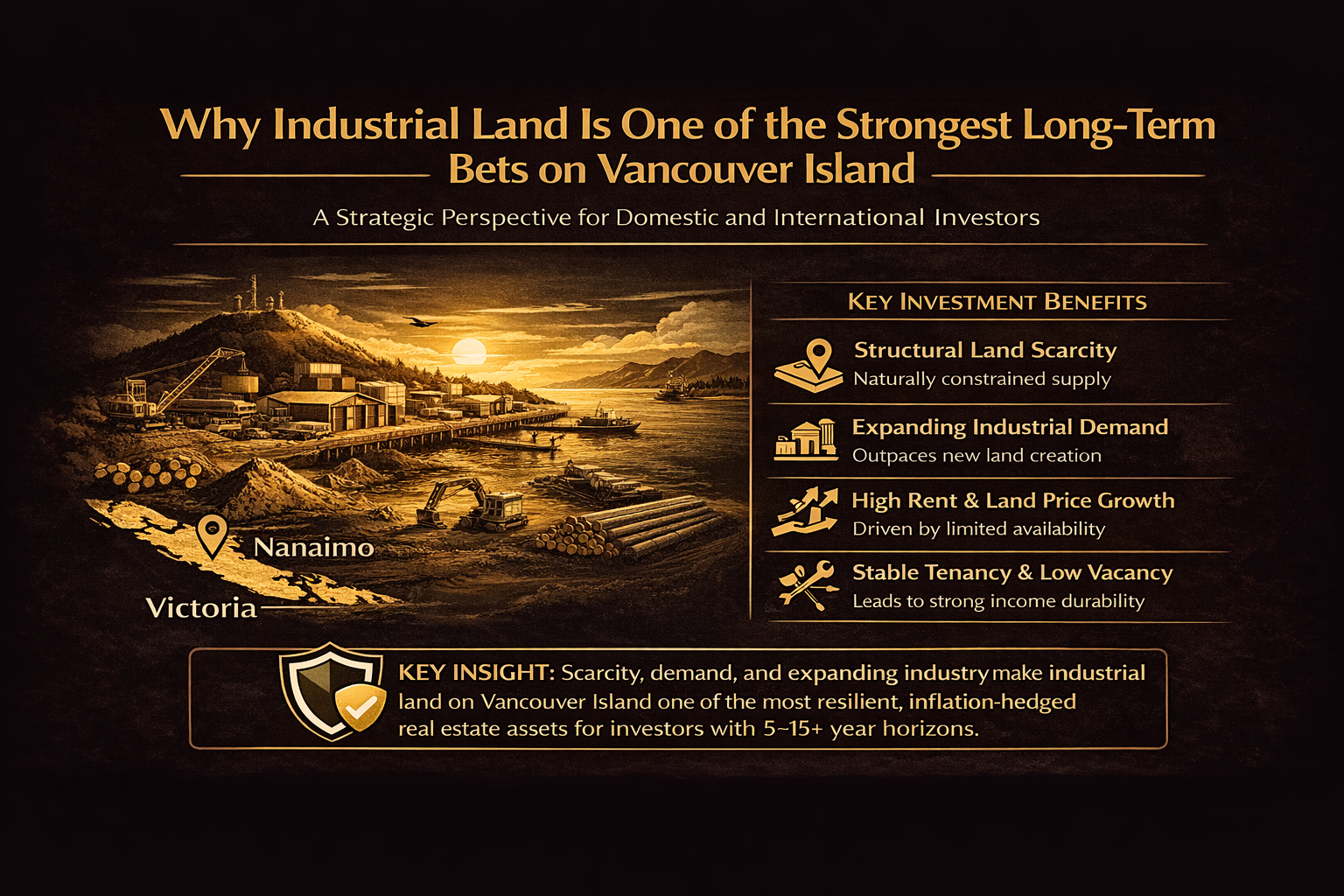
Why Industrial Land Is One of the Strongest Long-Term Bets on Vancouver Island

Industrial land has become one of the most compelling long-term investment opportunities on Vancouver Island. With strong demand drivers, chronic land scarcity, and a rapidly expanding industrial user base, the region presents a unique environment where industrial land consistently outperforms traditional commercial asset classes.

For investors — particularly those with multi-year horizons or an interest in strategic land banking — Vancouver Island offers a structurally advantaged market with limited downside risk and meaningful appreciation potential.

This article outlines the fundamental forces that make industrial land one of the strongest long-term real estate plays in the region.

This infographic highlights why industrial land on Vancouver Island represents a compelling long-term investment opportunity, driven by limited supply, strong population growth, and sustained demand from trades, logistics, and service-based industries. With structural land constraints and increasing competition for serviced sites, industrial land offers scarcity-driven appreciation and resilient, long-duration value for investors.

1. Structural Land Scarcity Creates Long-Term Value Protection

Unlike many North American markets with abundant industrial land, Vancouver Island faces natural, political, and geographic constraints that severely limit future supply:

  • Island geography (finite landmass)

  • ALR (Agricultural Land Reserve) protections

  • Limited flat topography suitable for industrial uses

  • Long municipal planning and rezoning timelines

  • Competition from residential and mixed-use development

The result is a persistently constrained supply pipeline, where new industrial land rarely enters the market.

This structural scarcity acts as a long-term value stabilizer, supporting predictable appreciation over multi-year periods.


2. Industrial Demand Is Expanding Faster Than New Supply

Multiple industries are driving strong and sustained demand for industrial-zoned land:

  • Construction and trades

  • Logistics and distribution

  • Marine and port-related services

  • Automotive services

  • Fabrication and light manufacturing

  • Equipment storage and contractor yards

  • Technology, film, and specialty production

Vancouver Island’s population continues to grow above the national average, further accelerating demand for services that depend on industrial land.

In most submarkets, demand significantly exceeds available supply, creating upward pressure on both lease rates and land values.


3. Exceptional Tenant Retention and Low Vacancy Rates

Industrial tenants — particularly trades, contractors, marine operators, and service businesses — have limited relocation flexibility. Their operations often depend on:

  • Yard space

  • Ceiling height

  • Access to major corridors

  • Proximity to labour and clients

These location-specific needs drive:

  • High tenant retention rates

  • Minimal vacancy

  • Strong occupancy stability during economic cycles

Unlike office and some retail properties, industrial land and small-bay industrial uses remain resilient through differing market environments.


4. Versatile Exit Strategies for Investors

Industrial land offers multiple exit strategies depending on investor goals:

A) Hold-and-Wait Appreciation Strategy

Land values have risen steadily over the past decade, especially in:

  • Nanaimo

  • Langford

  • Parksville

  • Campbell River

  • Comox Valley

A simple long-term hold often generates attractive risk-adjusted returns with minimal management burden.

B) Build-to-Suit Development

Investors can partner with contractors or developers to build specialized facilities for industrial tenants who prefer long-term leases.

C) Lease for Yard Use (Where Permitted)

In markets with severe industrial shortages, even basic yard space is highly sought after by:

  • Contractors

  • Storage operators

  • Service companies

D) Resale to Owner-Users or Developers

Owner-users are a major force in this market, often willing to pay a premium for functional industrial parcels.

This exit flexibility is a major advantage compared to highly specialized asset classes.


5. Industrial Land Is Operationally Simple Compared to Built Assets

Owning industrial land is often significantly simpler than managing built structures:

  • No building envelope issues

  • Minimal maintenance

  • Lower operating costs

  • Fewer capital expenditure requirements

  • Fewer tenant improvements needed

For investors seeking a low-maintenance, long-term strategy, industrial land offers a scalable and operationally efficient approach.


6. Strong Long-Term Appreciation Supported by Fundamentals

Industrial land on Vancouver Island benefits from:

  • Growing population and strong job creation

  • Expanding trades and logistics sectors

  • Infrastructure investments

  • Limited new serviced industrial subdivisions

  • Increased demand from owner-users, not only investors

This combination supports a resilient long-term appreciation profile with historically low volatility.


7. Ideal for Long-Term International Investors Seeking Stability

For UK and international investors, industrial land presents:

  • A defensive asset class

  • A hedge against inflation

  • Low correlation with traditional financial markets

  • Stability during economic cycles

  • High scarcity value

Foreign investors can acquire industrial land without restrictions, and ownership can be structured through personal, corporate, or trust vehicles.


Conclusion

Industrial land on Vancouver Island represents one of the most structurally advantaged real estate opportunities in Western Canada. Scarcity, demand, and long-term regional growth create an environment where industrial land is positioned for continued appreciation and strategic value.

For investors seeking stability, inflation protection, and long-term upside, industrial land offers a compelling, resilient, and institutionally supported investment thesis.


Frequently Asked Questions

What types of industrial properties are available in Nanaimo?
Nanaimo offers a mix of small-bay industrial units, warehouse space, service-commercial buildings, and limited industrial land opportunities.

What are typical industrial cap rates in Nanaimo?
Industrial cap rates generally range between 4.75% and 6.25%, depending on tenant quality, lease terms, and location.

Why is industrial land scarce in Nanaimo?
Supply is constrained due to island geography, Agricultural Land Reserve (ALR) restrictions, and limited serviced industrial zoning.

Is Nanaimo a good market for industrial investment?
Yes, strong population growth, low vacancy, and limited supply make Nanaimo an attractive long-term industrial market.


Read

Home Buyers Service

Finding the perfect home is more than just searching listings — it’s about understanding your needs, lifestyle, and future goals. I guide you through every step of the buying process, from exploring neighbourhoods and arranging viewings to negotiating the best possible terms for your purchase.

Whether you’re a first-time buyer or an experienced homeowner, I provide the local market insights, professional advice, and trusted connections you need to make confident decisions. Together, we’ll ensure your home-buying experience is seamless, informed, and truly rewarding.

Home Buyers Service

Finding the perfect home is more than just searching listings — it’s about understanding your needs, lifestyle, and future goals. I guide you through every step of the buying process, from exploring neighbourhoods and arranging viewings to negotiating the best possible terms for your purchase.

Whether you’re a first-time buyer or an experienced homeowner, I provide the local market insights, professional advice, and trusted connections you need to make confident decisions. Together, we’ll ensure your home-buying experience is seamless, informed, and truly rewarding.

MLS® property information is provided under copyright© by the Vancouver Island Real Estate Board and Victoria Real Estate Board. The information is from sources deemed reliable, but should not be relied upon without independent verification.