
A 2026 Perspective for International Buyers Considering Vancouver Island
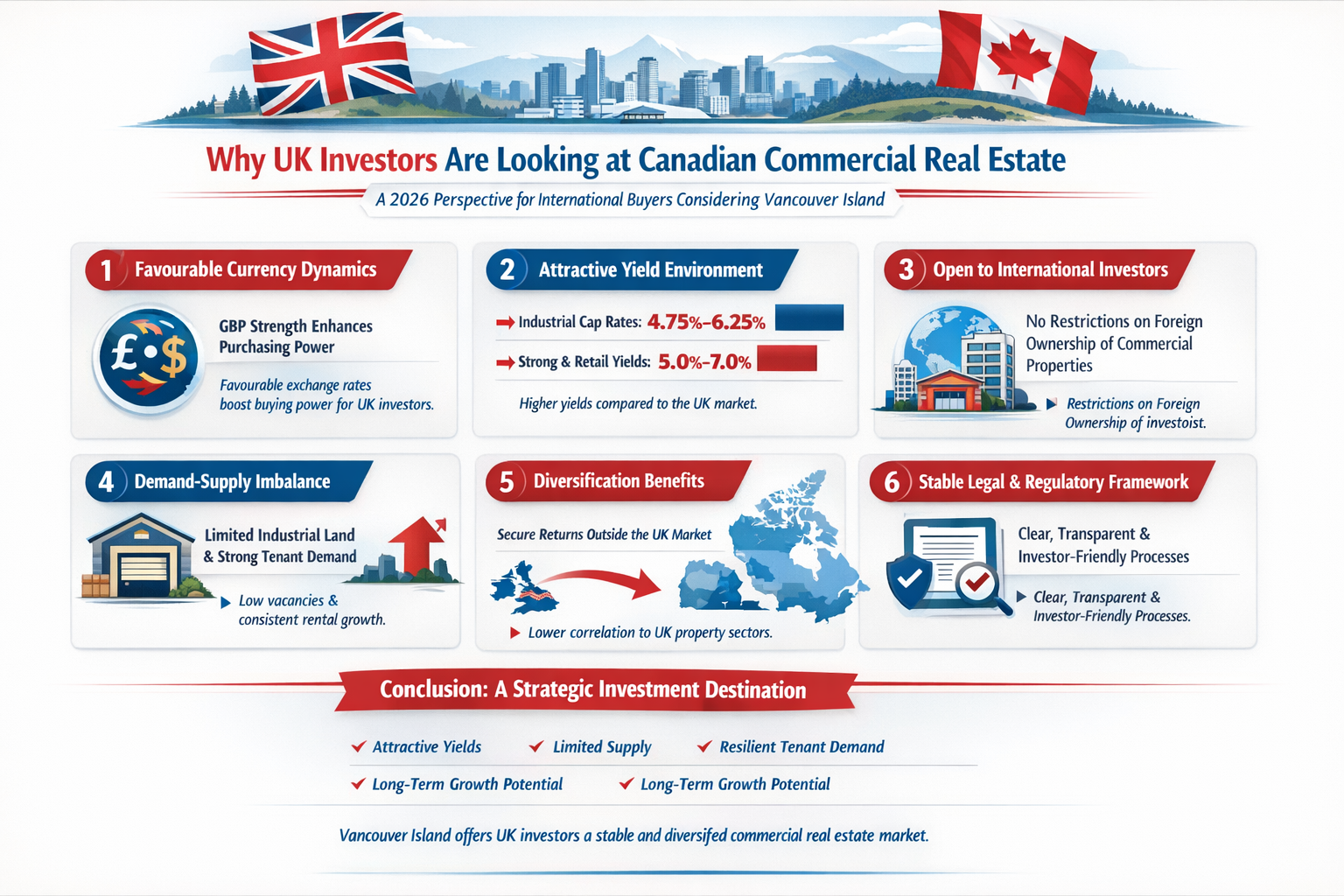
Over the last several years, a growing number of UK-based investors have been reallocating capital into Canadian commercial real estate. The trend is driven by a combination of favourable currency dynamics, the search for yield in a higher-rate UK environment, and Canada’s reputation as a safe, transparent, and institutionally mature market.
Within Canada, Vancouver Island has emerged as a strategic destination due to strong population growth, limited industrial supply, and resilient tenant demand. For UK investors seeking stable cash flow and long-term capital preservation, the region presents a compelling alternative to domestic assets.
This article outlines the structural reasons behind this shift and why Vancouver Island is increasingly on the radar of international buyers.
1. Favourable Currency Dynamics: GBP Strength Enhances Purchasing Power
The relative strength of the British Pound against the Canadian Dollar has made Canadian commercial assets meaningfully more accessible to UK investors. In periods where the GBP trades at a premium to CAD, investors effectively acquire properties at a discount, enhancing both yield and projected returns.
Currency dynamics are not the primary driver of investment decisions, but they improve entry pricing and support total return profiles, especially for income-producing assets.
2. Attractive Yield Environment Compared to the UK
Commercial yields in the UK have compressed over time, particularly in London and major regional centres. Higher financing costs have further pressured leveraged return profiles.
In contrast, Canada—and specifically Vancouver Island—offers:
Industrial cap rates between 4.75% and 6.25%
Service commercial and small-bay properties often above 5.5%
Retail/mixed-use opportunities between 5.0% and 7.0%, depending on tenancy
These yields stand out for international buyers seeking stable, risk-adjusted returns in markets with strong fundamentals and lower tenant turnover.
3. Commercial Real Estate Is Open to International Investors
One of the most significant advantages for overseas investors is that Canada does not restrict foreign ownership of commercial or industrial real estate.
Restrictions apply only to certain residential categories — not to income-producing properties or commercial land.
This regulatory openness provides clarity and accessibility, allowing UK investors to deploy capital efficiently without structural barriers.
4. Vancouver Island’s Demand-Supply Imbalance Favors Investors
Vancouver Island faces a chronic shortage of industrial and service-commercial space due to:
Limited land available for industrial zoning
Strong and growing population inflows
Expansion of logistics, trades, construction, marine, and service industries
High tenant retention and extremely low vacancies in several submarkets
This imbalance has historically supported:
Consistent rental growth
Stable occupancy
Appreciation of industrial land values
Predictable income streams
Unlike more volatile metropolitan regions, the Island’s growth is steady, diversified, and long-term.
5. Diversification Benefits Beyond the UK Market
Canadian commercial markets behave differently from those in the UK. As a result, Vancouver Island can serve as a diversification tool for global portfolios by offering:
Exposure to a different economic cycle
A region supported by migration, population growth, and sustained municipal infrastructure investment
A lower correlation to UK commercial sectors such as office, retail, and metropolitan multifamily
For investors accustomed to concentrated UK property portfolios, Canada offers a geographically and sectorally differentiated income stream.
6. Transparent Legal & Regulatory Framework
Canada’s transaction and ownership processes are straightforward and investor-friendly:
Clear title systems
Reliable legal protections
Standardized due diligence procedures
Widespread use of digital signing, enabling remote transactions
Professional ecosystem of lawyers, appraisers, inspectors, and property managers
This transparency is particularly appealing to investors looking for predictability and clean governance.
7. Seamless Remote Ownership & Management Options
For overseas investors, the practicality of managing assets is often a key concern.
Vancouver Island has a strong base of local property managers who provide:
Rent collection
Tenant communication
Repairs and maintenance coordination
Financial reporting
On-site oversight
This operational support makes foreign ownership feasible and hands-off, even from thousands of miles away.
Conclusion: A Strategic Market for Global Investors
UK investors are increasingly drawn to Canadian commercial real estate for its:
Attractive yields
Stable regulatory environment
Strong fundamentals in industrial and service-commercial sectors
Favourable currency positioning
Long-term growth outlook
Vancouver Island stands out as a market with structural strengths: limited supply, resilient tenant demand, and steady population growth create a favourable environment for income-focused investors seeking diversification and stability.
For investors evaluating global opportunities, Vancouver Island represents a strategic, well-supported, and institutionally reliable destination to deploy capital.
Frequently Asked Questions
Can foreign investors buy commercial real estate in Canada?
Yes, there are no restrictions on foreign ownership of commercial or industrial properties.
Do foreign buyers need to be in Canada to complete a purchase?
No, transactions can be completed remotely with the support of legal and professional advisors.
Can foreign investors obtain financing in Canada?
Yes, although loan-to-value ratios may be lower and underwriting requirements more stringent.
What taxes apply to foreign investors?
Foreign investors are subject to standard transaction costs such as property transfer tax, but no additional foreign buyer tax applies to commercial assets.
