
A Comparative Analysis for Commercial and Industrial Investors
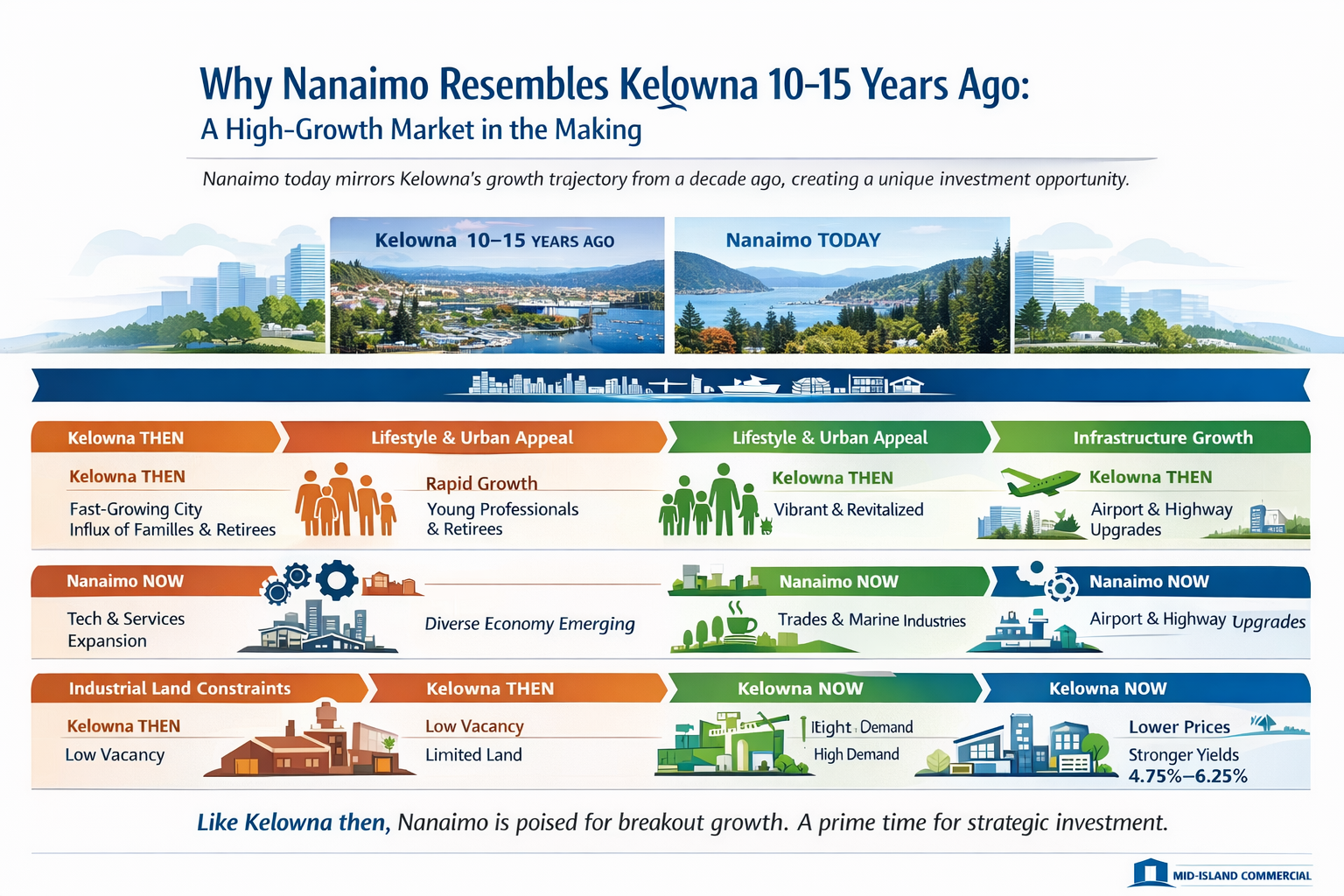
Kelowna is widely recognized as one of Canada’s most successful mid-sized city growth stories. Over the last decade, the region has experienced significant appreciation in residential, commercial, and industrial real estate, driven by population growth, economic diversification, constrained land supply, and lifestyle-driven migration.
Increasingly, investors are observing that Nanaimo today mirrors Kelowna’s profile from 10–15 years ago. From demographic trends to economic drivers, land scarcity, and commercial demand, the similarities are striking — but Nanaimo still remains in an earlier, more accessible phase of its growth cycle.
This article outlines the key parallels and explains why Nanaimo is positioned to follow a similar trajectory.
1. Population & Migration Trends: An Echo of Kelowna’s Growth Surge
Kelowna (10–15 Years Ago)
One of Canada’s fastest-growing cities
Strong inflow of young families, remote workers, and retirees
Significant interprovincial migration
Rapid suburban expansion and new neighbourhood growth
Nanaimo (Today)
Among BC’s fastest-growing mid-sized cities
Attracting a similar mix of:
Young professionals
Trades and skilled labour
Remote workers
Retirees
Growth accelerating in North Nanaimo, South Nanaimo, and surrounding regional districts
Key Insight:
Demographics were a major catalyst for Kelowna’s real estate boom — and Nanaimo is on the same trajectory.
2. Lifestyle-Driven Demand & Emerging Urban Appeal
Kelowna (10–15 Years Ago)
Began transitioning from a seasonal/tourism market to a year-round lifestyle and employment hub
Increased interest from Greater Vancouver migrants
Growth of culture, dining, and urban amenities
Nanaimo (Today)
Experiencing similar transformation:
More amenities, restaurants, and urban renewal
Downtown revitalization activity
Strong appeal to Vancouver residents seeking affordability and quality of life
Increasingly viewed as a balanced lifestyle + opportunity destination
Key Insight:
Lifestyle migration was a major driver of Kelowna’s growth — and Nanaimo is attracting the same demographic profile.
3. Economic Diversification Patterns: Nanaimo Is Following Kelowna’s Path
Kelowna (10–15 Years Ago)
Expanded beyond tourism into:
Tech
Professional services
Healthcare
Construction
Education and research
Saw a surge in entrepreneurship and small businesses
Nanaimo (Today)
Now experiencing similar diversification:
Rapid growth in construction and trades
Expansion of healthcare and education
More professional services
Growth in marine, logistics, and supporting industries
Increased entrepreneurship and small business formation
Key Insight:
As Kelowna diversified, commercial and industrial demand surged — Nanaimo is at this inflection point now.
4. Industrial & Commercial Supply Constraints: A Familiar Pattern
Kelowna (10–15 Years Ago)
Limited industrial land due to geography and zoning
Strong demand from growing trades and service industries
Industrial vacancy compressed significantly
Land values climbed steadily
Nanaimo (Today)
Shows the same supply-demand imbalance:
Severe shortage of industrial land
High tenant retention for industrial and service-commercial properties
Scarce small-bay industrial inventory
Strong demand from construction, trades, equipment operators, and marine-related tenants
Key Insight:
Industrial scarcity was the foundation of Kelowna’s commercial appreciation — Nanaimo’s long-term supply constraints signal similar upward potential.
5. Infrastructure Investment: Nanaimo’s Expansion Mirrors Kelowna’s Past Cycle
Kelowna's Growth Phase
Airport expansion (YLW) transformed connectivity
New commercial nodes and retail hubs emerged
Major road and corridor improvements
Nanaimo Today
Airport expansion (YCD) and more destinations
Highway and corridor upgrades improving regional movement
South and North Nanaimo evolving into major commercial centres
Marine, ferry, and logistics infrastructure strengthening
Key Insight:
Infrastructure investment preceded Kelowna’s rise — Nanaimo is now entering a similar acceleration phase.
6. Pricing & Yield Comparison: Nanaimo Is Earlier in the Value Curve
Kelowna Today
Industrial and commercial pricing has appreciated significantly
Cap rates compressed due to competition and low supply
Owner-user demand pushes pricing beyond many private investors
Nanaimo Today
Still offers:
Lower entry pricing
More favourable yields (4.75%–6.25%)
Stronger risk-adjusted return potential
Market still accessible for private and international buyers
Key Insight:
Nanaimo is at a point similar to Kelowna’s “pre-breakout” phase — offering better upside and more accessible entry.
7. Investor Behaviour: Early Accumulation Phase in Nanaimo
Kelowna’s Early Cycle (10–15 Years Ago)
Private investors began accumulating industrial strata
Developers targeted service-commercial and mixed-use projects
Owner-users increased demand for industrial land
Nanaimo Now
Similar patterns:
Growing competition for small-bay industrial
More owner-users entering early
Increased developer interest
Early-stage land banking strategies emerging
Key Insight:
The same early signals seen in Kelowna’s growth cycle are appearing now in Nanaimo.
Conclusion
Although every market is unique, the parallels between Nanaimo today and Kelowna 10–15 years ago are compelling. Both cities share:
Strong population growth
Lifestyle-driven migration
Expanding economic diversification
Chronic industrial land shortages
Infrastructure investment
Growing business and service ecosystems
Kelowna’s trajectory offers a useful blueprint for understanding Nanaimo’s long-term potential. As Nanaimo continues its transformation, its commercial and industrial markets offer attractive opportunities for investors seeking early entry into a rising regional hub.
Frequently Asked Questions
Why is Nanaimo compared to Kelowna?
Both markets share similar growth patterns, including population growth, lifestyle migration, and limited land supply.
Is Nanaimo still early in its growth cycle?
Yes, many investors view Nanaimo as being 10–15 years behind Kelowna in terms of development and pricing.
What sectors are driving growth in Nanaimo?
Construction, trades, logistics, healthcare, and small business expansion are key drivers.
Is now a good time to invest in Nanaimo?
Early-stage markets often offer better entry pricing and long-term upside potential.
Helpful Resources
👉
👉
