
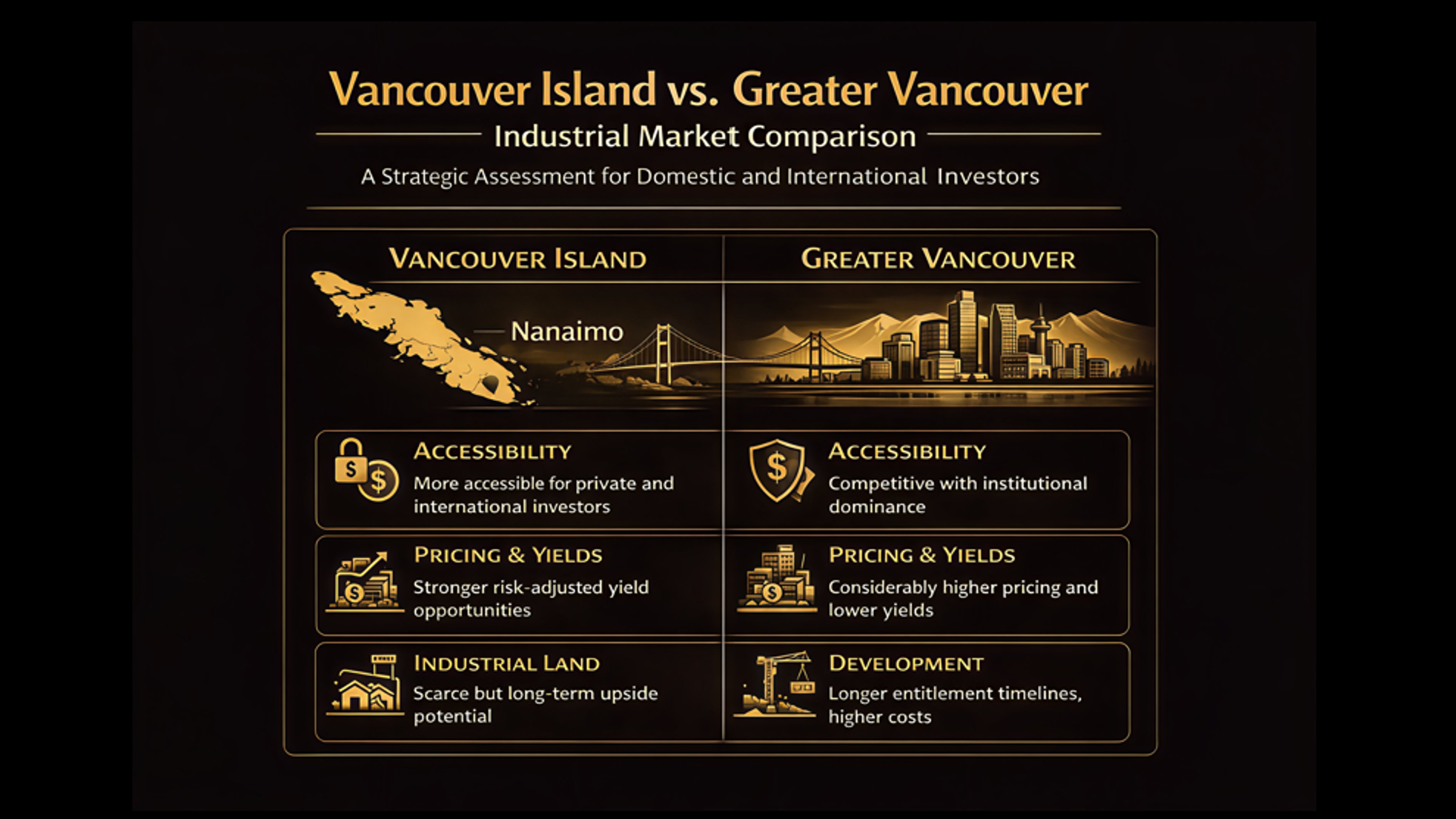
Industrial real estate remains one of the most resilient and sought-after asset classes in Western Canada. While Greater Vancouver is widely viewed as the dominant industrial market in the region, Vancouver Island has quietly emerged as a high-performing, strategically compelling alternative for investors seeking stable yields, resilient demand, and long-term value appreciation.
This comparative analysis outlines the key differences between the two markets from an investment perspective, with a focus on fundamentals, supply dynamics, pricing, and future opportunities.
1. Market Size vs. Market Accessibility
Greater Vancouver
One of Canada’s largest and most mature industrial markets
Highly competitive with institutional dominance
Large-scale assets often traded off-market among REITs, pension funds, and private equity
Entry pricing can be prohibitive for many private investors
Vancouver Island
Smaller but rapidly growing industrial ecosystem
More accessible for private investors (local and international)
Attractive opportunities in small-bay strata, service commercial, and land
Owner-user demand creates strong price support across cycles
Key Insight:
Greater Vancouver offers scale; Vancouver Island offers accessibility, stability, and lower barriers to entry.
2. Supply and Vacancy: Severe Constraint on Both Sides, But Different Drivers
Greater Vancouver
Vacancies near historical lows
Structural supply shortage due to limited industrial land and competing residential development
High-intensity distribution and logistics demand
Extremely tight lease availability, often absorbed before completion
Vancouver Island
Similarly low vacancy, driven by trades, construction, marine, and service industries
Chronic shortage of small-bay and mid-bay industrial units
Limited industrial land due to geography, zoning, and ALR protections
High tenant retention due to location-specific operational needs
Key Insight:
Both regions suffer from industrial scarcity, but Vancouver Island’s constraint is long-term structural, supporting resilient pricing and rental growth.
3. Pricing & Yields: Vancouver Island Leads on Risk-Adjusted Returns
Greater Vancouver
Among Canada’s highest industrial land and building costs
Cap rates often compress below 4.5% for high-quality assets
Strong international demand pushes pricing beyond many private investors’ reach
Institutional buyers dominate multi-tenant and logistics assets
Vancouver Island
More favourable cap rate ranges (4.75%–6.25% in many cases)
Lower absolute price points for industrial strata and land
Attractive for yield-focused and first-time commercial buyers
Less pricing volatility compared to large metro markets
Key Insight:
Investors seeking risk-adjusted yield find more favourable entry points on Vancouver Island without sacrificing tenant demand or occupancy stability.
4. Tenant Profiles: Logistics-Weighted vs. Service-Weighted
Greater Vancouver
Heavy concentration of logistics, warehousing, and distribution
Demand driven by e-commerce, port activity, and last-mile delivery
Large warehouse footprints dominate new supply
Vancouver Island
Strong presence of:
Trades and contractors
Construction-related services
Marine and port-support businesses
Automotive and equipment operators
Specialty manufacturers
Tenant demand closely linked to regional population growth and infrastructure expansion
Key Insight:
Vancouver Island’s tenant base is more diversified and less cyclical, providing consistent occupancy even during broader economic transitions.
5. Industrial Land: Scarcity Intensifies the Further You Go from the Mainland
Greater Vancouver
Industrial land remains scarce and expensive
Competition from residential developers for rezoning
High price floors due to institutional interest
Limited opportunities for private investors
Vancouver Island
Geography restricts expansion of industrial-zoned land
ALR and municipal planning reduce supply further
Owner-users create strong baseline demand for serviced industrial sites
One of the most attractive long-term appreciation plays in BC
Key Insight:
Industrial land scarcity is acute in both markets, but Vancouver Island offers entry pricing and long-term upside that Greater Vancouver cannot match.
6. Development Environment: Faster to Execute, but Still Constrained
Greater Vancouver
Longer entitlement timelines
Higher development costs
More complex municipal processes
Labour and material constraints impact construction schedules
Vancouver Island
Approvals can be faster in certain municipalities
Lower land and construction costs (though rising)
Strong demand for build-to-suit industrial and contractor yards
Limited competition among developers in the industrial segment
Key Insight:
For investors looking at value-add or development plays, Vancouver Island provides more achievable entry points with strong user demand.
7. Investment Thesis Summary
Greater Vancouver
Global gateway market
Highly liquid but highly competitive
Institutional buyer dominance
Lower yields
Strong long-term fundamentals
Vancouver Island
Strong population and economic growth
Limited industrial inventory
High tenant retention
Attractive yields
Lower volatility and easier access for private investors
Excellent for industrial land banking and small-bay strategies
Conclusion
While Greater Vancouver remains a powerhouse industrial market, Vancouver Island offers a compelling alternative for both domestic and international investors. With favourable yields, strong demand, chronic land scarcity, and lower barriers to entry, the Island presents a strategic opportunity for investors seeking stability, income, and long-term value appreciation.
For buyers evaluating Western Canadian industrial options, Vancouver Island stands out as a high-quality market with a strong risk-adjusted return profile.
Helpful Resources
👉
👉
👉
