
For many international investors — especially those from the UK and Europe — commercial leasing terminology in Canada can appear unfamiliar. Terms such as NNN, net lease, additional rent, and CAM charges are commonly used in Canadian commercial property contracts, and understanding these concepts is essential for evaluating cash flow and risk.
This article provides a clear, structured overview of the main lease structures in Canada and how they affect investment performance. The examples are broadly applicable across the country but especially relevant to Vancouver Island’s industrial, retail, and service-commercial markets.
1. The Three Primary Lease Structures in Canada
Commercial leases in Canada typically fall into one of three categories:
Triple Net (NNN) Lease
Net Lease (Semi-Net) or Modified Net Lease
Gross or Fully Gross Lease
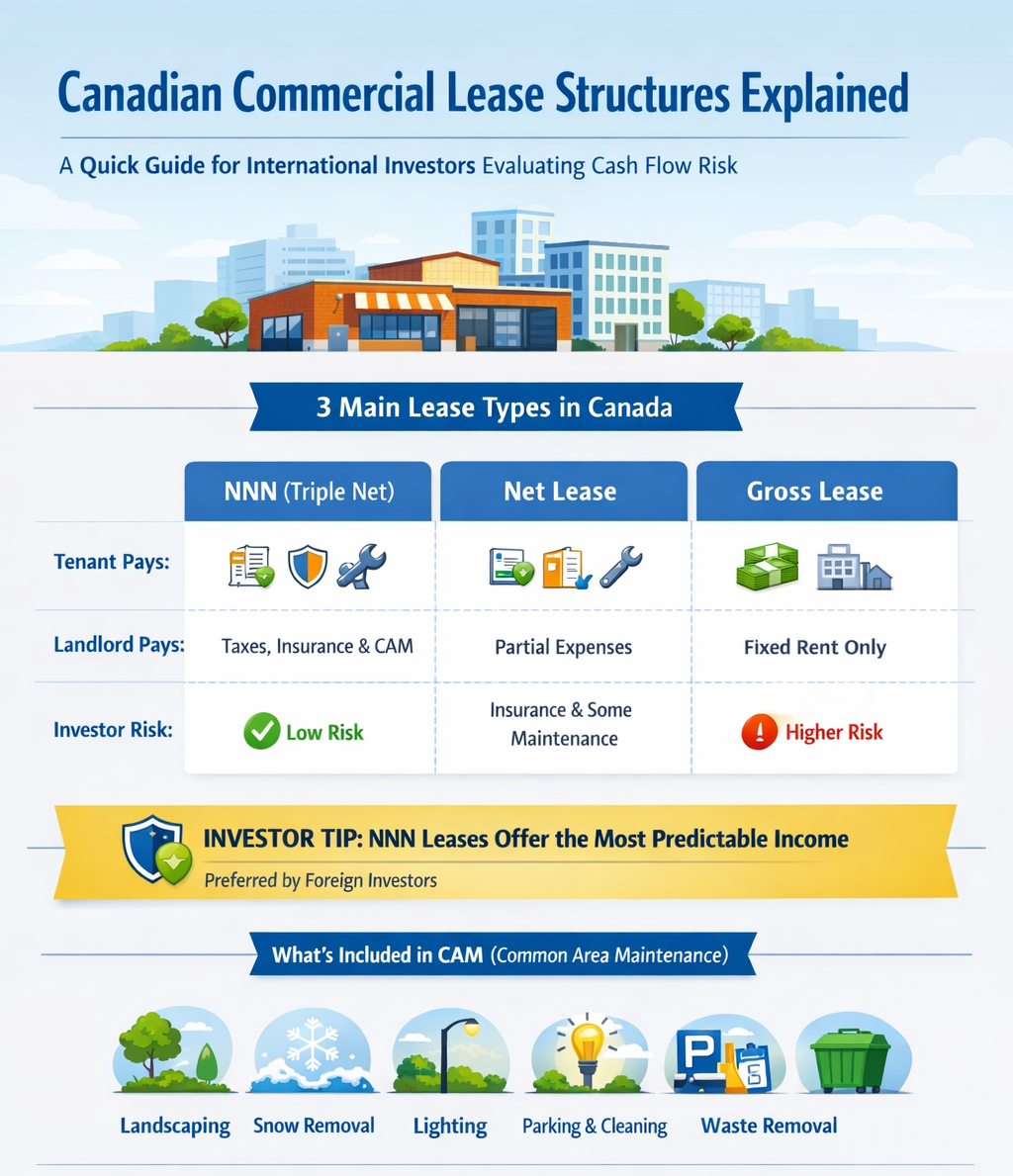
These structures determine how operating expenses, taxes, insurance, and maintenance costs are allocated between landlord and tenant — and therefore impact the property’s Net Operating Income (NOI) and risk profile.
2. Triple Net (NNN) Lease
Most Common Form for Industrial & Retail on Vancouver Island
A Triple Net Lease is the dominant structure for industrial and service-commercial properties.
Under an NNN lease, the tenant pays:
Property taxes
Building insurance
Common area maintenance (CAM)
Utilities (depending on metering)
Base rent
The landlord typically pays:
Structural repairs
Roof (depending on the lease)
Building envelope
Capital improvements
Why investors prefer NNN leases:
Highly predictable cash flow
Lower operating expense variability
Operating costs are passed through to the tenant
NOI is stable across inflationary environments
Minimal landlord involvement in day-to-day operations
Example on Vancouver Island:
A trades or logistics tenant occupying a small-bay industrial unit typically pays:
Base rent (e.g., $16/sq.ft.)
Additional rent (NNN) (e.g., $8–$12/sq.ft.)
This structure is ideal for overseas investors due to its simplicity and income transparency.
3. Net Lease (Modified Net or Semi-Net Lease)
Shared Responsibilities, Often Used in Older Assets
In a Net Lease, the tenant pays some — but not all — operating expenses. The division of responsibilities varies by contract.
A typical Modified Net lease may involve:
Tenant pays: property taxes + utilities
Landlord pays: building insurance, some maintenance, structural repairs
Investor considerations:
NOI may have slightly higher volatility
Lease clarity in the contract is essential
Operating expenses should be underwritten conservatively
These leases often appear in older industrial buildings or certain retail properties where the landlord retains more responsibility.
4. Gross and Fully Gross Leases
Tenant Pays One Fixed Amount; Landlord Covers Most or All Operating Costs
A Gross Lease means the tenant pays a single fixed rental amount, and the landlord pays:
Property taxes
Insurance
Maintenance
Common area costs
Utilities (sometimes)
Implications for investors:
NOI is more sensitive to increases in operating expenses
Inflation or property tax increases reduce margin
Strong expense controls are essential
Rent escalations must account for rising costs
Gross leases are more common in:
Office environments
Smaller retail spaces
Properties where the landlord manages more operational aspects
For international investors, gross leases require deeper underwriting due to their expense sensitivity.
5. Understanding CAM (Common Area Maintenance) Charges
CAM charges are a key component of additional rent under NNN and Net leases.
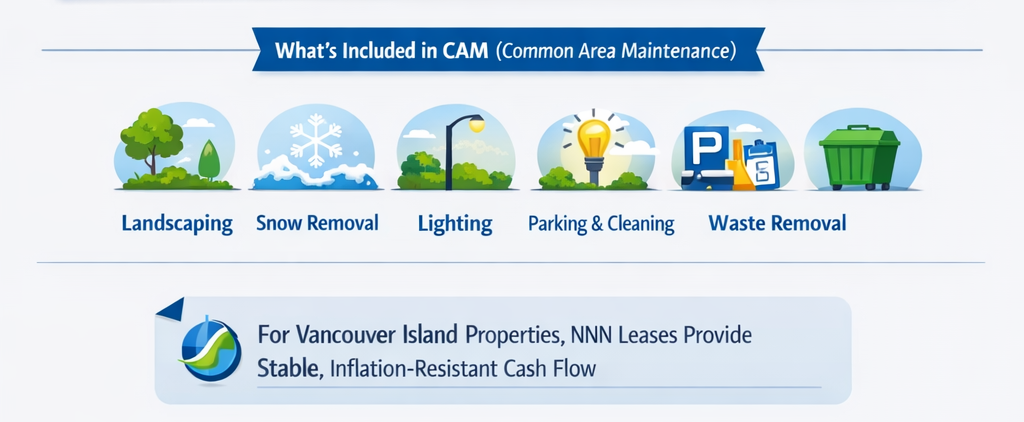
They typically include:
Landscaping
Parking lot maintenance
Lighting
Waste removal
Snow removal
Common area cleaning
Repairs to shared areas
Property management costs
CAM is typically reconciled annually, meaning tenants may receive a credit or debit depending on actual vs. estimated costs.
Why CAM matters for investors:
Clear CAM provisions protect NOI
Ambiguity can create disputes or unexpected costs
High-quality leases detail CAM inclusions and exclusions
A well-written CAM clause supports predictable, low-friction landlord–tenant relationships.
6. Additional Rent: A Canadian Leasing Term Every Investor Should Know
In Canada, additional rent is a collective term used in net leases to describe:
NNN charges
CAM fees
Property taxes
Insurance costs
Any other operating expenses passed through to tenants
This is similar to service charges in the UK, but typically more comprehensive.
Understanding additional rent is essential for accurate underwriting and cash flow modelling.
7. Which Lease Structure Is Best for Overseas Investors?
For international buyers who prefer predictable income and lower management burden:
Triple Net (NNN) leases are generally the most suitable.
They provide:
Stable NOI
Lower volatility
Minimal landlord involvement
Clear allocation of expenses
Natural inflation protection (through pass-through expenses and escalations)
NNN leases are particularly common in Vancouver Island’s industrial and service-commercial sectors — making them ideal for foreign investors seeking simplicity and stability.
Conclusion
Understanding Canadian lease structures is a key part of evaluating commercial real estate. Whether the property is leased under an NNN, Net, or Gross agreement, the clarity of the lease contract and the alignment of responsibilities between landlord and tenant significantly impact investment performance.
For overseas investors, NNN leases provide the most predictable and low-maintenance cash flow, which aligns well with long-distance ownership.
Gross and Net leases require deeper underwriting but can offer attractive opportunities when priced appropriately.
With disciplined analysis and the right advisory support, international investors can navigate Canadian lease structures with confidence.
