

A Comprehensive 2025 Guide for International & UK-Based Investors
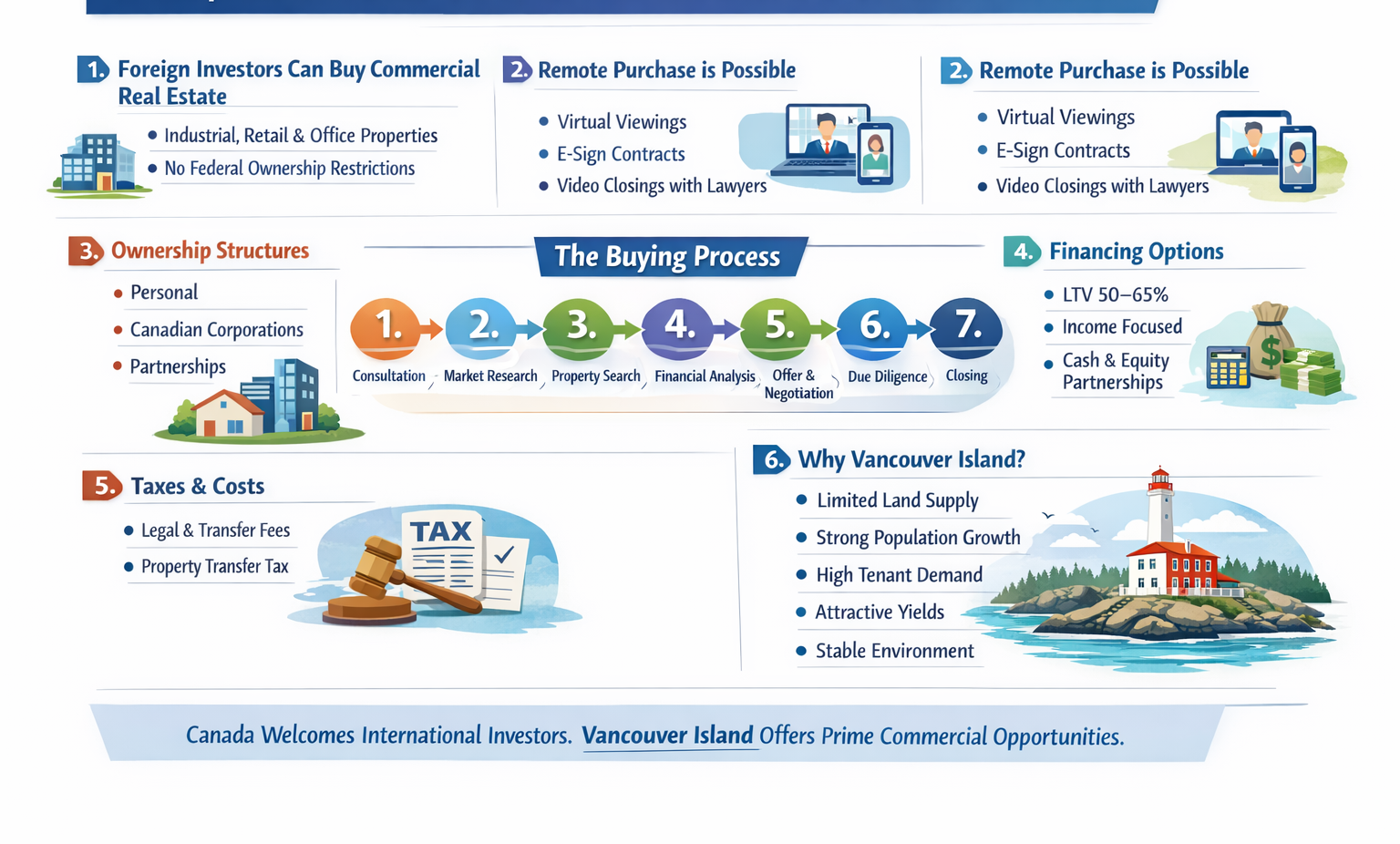
Canada continues to attract international investors seeking stable, income-producing commercial real estate. Known for its transparent legal system, well-regulated financial markets, and strong economic fundamentals, the country offers a reliable environment for deploying capital.
One of the most common questions from overseas investors — especially from the UK — is whether foreign ownership restrictions apply to commercial real estate. The short answer:
Foreign investors can freely purchase commercial and industrial properties in Canada.
There are no federal restrictions on foreign ownership of commercial assets.
This guide outlines the process, requirements, and considerations for international investors entering the Canadian commercial market, with a focus on Vancouver Island.
1. Foreign Investors Are Allowed to Buy Commercial Real Estate in Canada
Canada’s foreign buyer restrictions apply only to certain residential properties.
Commercial and industrial properties are exempt from these rules, meaning:
UK investors
Non-residents
International corporations
Trusts and investment vehicles
may all freely acquire commercial assets such as:
Industrial units
Warehouses
Retail or mixed-use commercial properties
Office units
Service commercial spaces
Commercial or industrial land
This regulatory clarity provides foreign investors with unrestricted access to one of the world’s most stable real estate markets.
2. Do You Need to Be Physically Present in Canada?
No.
The entire acquisition process can be completed remotely, including:
Viewing properties virtually
Requesting financial and lease documentation
Signing offers and contracts via secure platforms
Coordinating due diligence with local professionals
Closing with a Canadian lawyer via video call
Remote transactions are common and fully supported by Canadian legal frameworks.
3. How Foreign Buyers Typically Structure Ownership
International investors can own property in Canada in several ways:
A) Personal ownership
Simple, direct, and suitable for smaller investments.
B) Canadian corporation (often preferred)
Advantages may include:
Clear separation of liability
Potential financing flexibility
Ease of ownership transfer
Professional image for tenants
C) Partnership or joint venture structures
Used when co-investing with local partners or other investors.
D) Trust or holding structures
Less common but available depending on tax planning needs.
The ideal structure varies based on:
Tax strategy
Size of investment
Risk profile
Long-term objectives
A consultation with tax and legal advisors is recommended before finalizing the chosen vehicle.
4. Financing Options for Foreign Investors
Foreign buyers can obtain financing in Canada, though underwriting is more conservative and documentation requirements are higher.
Financing considerations include:
Loan-to-value (LTV) ratios may be lower (e.g., 50–65% depending on profile)
Stronger emphasis on property income and tenant covenant
Additional documentation for creditworthiness
Preference for well-leased, income-producing assets
Alternatives for foreign buyers:
All-cash offers (common for smaller assets)
Corporate financing through a Canadian entity
Equity partnerships with local investors
Financing is not a barrier — the key is structuring the investment properly.
5. The Commercial Purchase Process for Foreign Investors
A successful acquisition typically follows a structured 7-step process:
Step 1 — Initial Consultation
Clarify goals, target yields, asset type, budget, and preferred timelines.
Step 2 — Market Overview
Understand the fundamentals of Vancouver Island’s market, including supply/demand dynamics, cap rates, tenant profiles, and economic drivers.
Step 3 — Opportunity Sourcing
A curated list of suitable properties is prepared, including:
On-market MLS listings
Select off-market opportunities
Comparative options across Nanaimo, Parksville, Langford, and other submarkets
Step 4 — Financial Analysis & Underwriting
Detailed evaluation including:
Income and expense breakdowns
Lease review
Sensitivity analysis
Cap rate and return projections
Market comparables
Step 5 — Offer Preparation & Negotiation
Terms may include:
Price
Deposit structure
Due diligence periods
Lease-related conditions
Completion timelines
Step 6 — Due Diligence
Professionals involved may include:
Appraisers
Environmental consultants
Inspectors
Lawyers
Surveyors
Lenders
Step 7 — Completion & Post-Closing
Documentation and funds transfer handled via your lawyer.
Property management options can be arranged for overseas owners.
6. Taxes, Fees, and Closing Costs
Foreign investors face the same commercial transaction costs as Canadian buyers. These typically include:
Legal fees
Appraisal fees (if financing)
Due diligence costs (inspection, environmental, etc.)
Provincial property transfer tax (varies by province)
There are no additional foreign buyer taxes on commercial property.
Annual considerations include:
Property taxes
Insurance
Accounting for Canadian corporate entities (if used)
A pre-investment tax briefing is recommended to optimize structure.
7. Why Many Foreign Investors Choose Vancouver Island
Vancouver Island offers a distinctive combination of:
✔ Limited industrial and commercial land supply
Geographic constraints and zoning limitations restrict new inventory.
✔ Strong population growth
Fueling demand for commercial services, trades, logistics, and retail.
✔ Resilient tenant demand
Particularly in industrial and service-commercial segments.
✔ Attractive yields
Compared to major UK and European markets.
✔ Stable, predictable investment environment
Low volatility and transparent regulations support long-term strategies.
For many global investors, the Island represents a defensive yet growth-oriented allocation within their real estate portfolio.
Conclusion
Foreign investors face no restrictions when purchasing commercial or industrial real estate in Canada. With a clear legal framework, strong fundamentals, and straightforward remote ownership options, the Canadian commercial market — particularly Vancouver Island — offers a compelling opportunity for UK and international capital.
Whether you are seeking stable income, strategic diversification, or long-term appreciation, Vancouver Island provides a reliable, well-supported platform for disciplined real estate investment.
Frequently Asked Questions
Can foreign investors buy commercial real estate in Canada?
Yes, there are no restrictions on foreign ownership of commercial or industrial properties.
Do foreign buyers need to be in Canada to complete a purchase?
No, transactions can be completed remotely with the support of legal and professional advisors.
Can foreign investors obtain financing in Canada?
Yes, although loan-to-value ratios may be lower and underwriting requirements more stringent.
What taxes apply to foreign investors?
Foreign investors are subject to standard transaction costs such as property transfer tax, but no additional foreign buyer tax applies to commercial assets.
