How Foreign Investors Can Purchase Commercial Real Estate in Canada

A Comprehensive 2025 Guide for International & UK-Based Investors
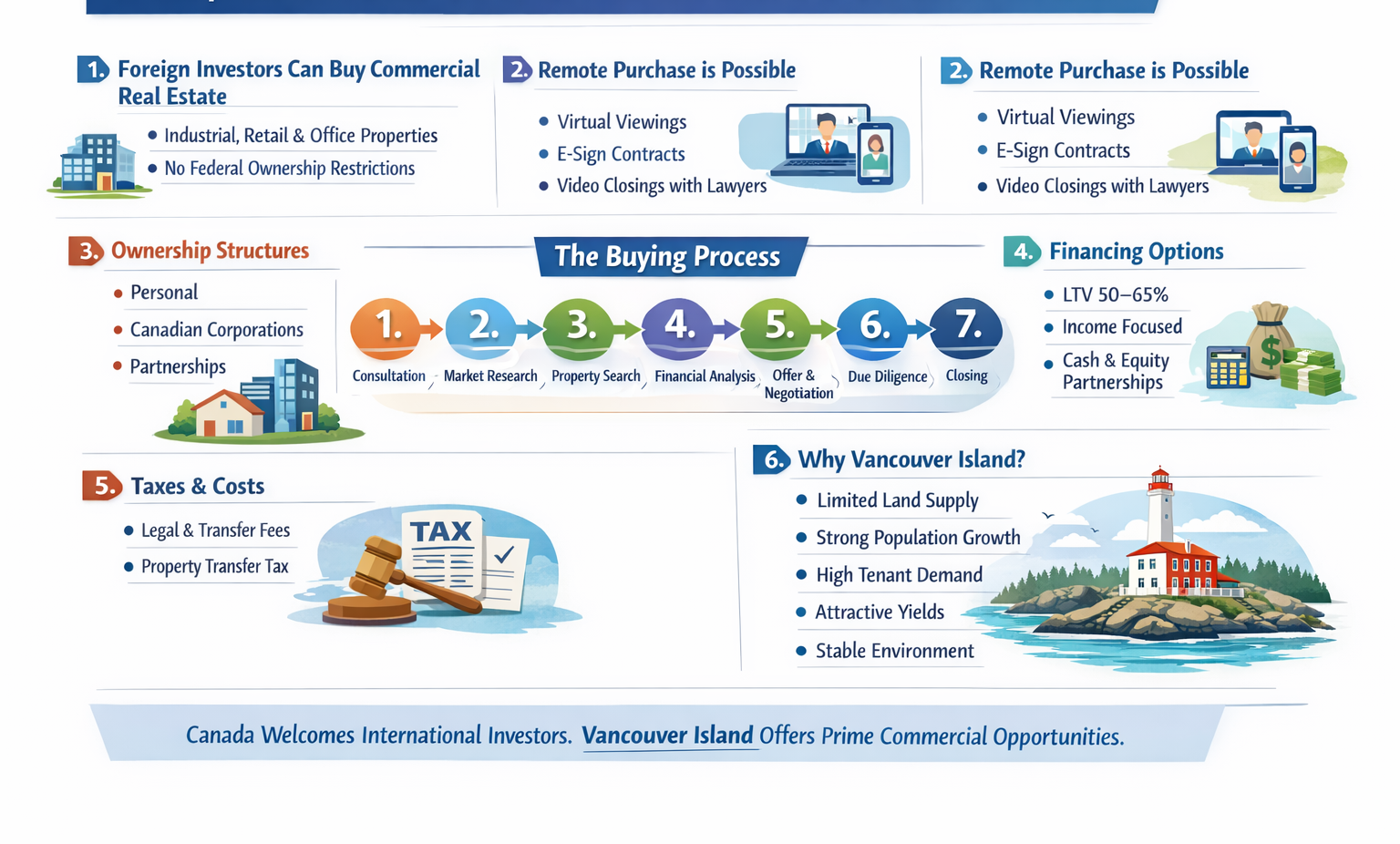
This infographic outlines how international investors can acquire commercial real estate in Canada, with a focus on Vancouver Island. It highlights ownership structures, financing considerations, and the step-by-step acquisition process within a transparent and investor-friendly legal framework.

Canada continues to attract international investors seeking stable, income-producing commercial real estate. Known for its transparent legal system, well-regulated financial markets, and strong economic fundamentals, the country offers a reliable environment for deploying capital.

One of the most common questions from overseas investors — especially from the UK — is whether foreign ownership restrictions apply to commercial real estate. The short answer:

Foreign investors can freely purchase commercial and industrial properties in Canada.

There are no federal restrictions on foreign ownership of commercial assets.

This guide outlines the process, requirements, and considerations for international investors entering the Canadian commercial market, with a focus on Vancouver Island.


1. Foreign Investors Are Allowed to Buy Commercial Real Estate in Canada

Canada’s foreign buyer restrictions apply only to certain residential properties.
Commercial and industrial properties are exempt from these rules, meaning:

  • UK investors

  • Non-residents

  • International corporations

  • Trusts and investment vehicles

may all freely acquire commercial assets such as:

  • Industrial units

  • Warehouses

  • Retail or mixed-use commercial properties

  • Office units

  • Service commercial spaces

  • Commercial or industrial land

This regulatory clarity provides foreign investors with unrestricted access to one of the world’s most stable real estate markets.


2. Do You Need to Be Physically Present in Canada?

No.
The entire acquisition process can be completed remotely, including:

  • Viewing properties virtually

  • Requesting financial and lease documentation

  • Signing offers and contracts via secure platforms

  • Coordinating due diligence with local professionals

  • Closing with a Canadian lawyer via video call

Remote transactions are common and fully supported by Canadian legal frameworks.


3. How Foreign Buyers Typically Structure Ownership

International investors can own property in Canada in several ways:

A) Personal ownership

Simple, direct, and suitable for smaller investments.

B) Canadian corporation (often preferred)

Advantages may include:

  • Clear separation of liability

  • Potential financing flexibility

  • Ease of ownership transfer

  • Professional image for tenants

C) Partnership or joint venture structures

Used when co-investing with local partners or other investors.

D) Trust or holding structures

Less common but available depending on tax planning needs.

The ideal structure varies based on:

  • Tax strategy

  • Size of investment

  • Risk profile

  • Long-term objectives

A consultation with tax and legal advisors is recommended before finalizing the chosen vehicle.


4. Financing Options for Foreign Investors

Foreign buyers can obtain financing in Canada, though underwriting is more conservative and documentation requirements are higher.

Financing considerations include:

  • Loan-to-value (LTV) ratios may be lower (e.g., 50–65% depending on profile)

  • Stronger emphasis on property income and tenant covenant

  • Additional documentation for creditworthiness

  • Preference for well-leased, income-producing assets

Alternatives for foreign buyers:

  • All-cash offers (common for smaller assets)

  • Corporate financing through a Canadian entity

  • Equity partnerships with local investors

Financing is not a barrier — the key is structuring the investment properly.


5. The Commercial Purchase Process for Foreign Investors

A successful acquisition typically follows a structured 7-step process:

Step 1 — Initial Consultation

Clarify goals, target yields, asset type, budget, and preferred timelines.

Step 2 — Market Overview

Understand the fundamentals of Vancouver Island’s market, including supply/demand dynamics, cap rates, tenant profiles, and economic drivers.

Step 3 — Opportunity Sourcing

A curated list of suitable properties is prepared, including:

  • On-market MLS listings

  • Select off-market opportunities

  • Comparative options across Nanaimo, Parksville, Langford, and other submarkets

Step 4 — Financial Analysis & Underwriting

Detailed evaluation including:

  • Income and expense breakdowns

  • Lease review

  • Sensitivity analysis

  • Cap rate and return projections

  • Market comparables

Step 5 — Offer Preparation & Negotiation

Terms may include:

  • Price

  • Deposit structure

  • Due diligence periods

  • Lease-related conditions

  • Completion timelines

Step 6 — Due Diligence

Professionals involved may include:

  • Appraisers

  • Environmental consultants

  • Inspectors

  • Lawyers

  • Surveyors

  • Lenders

Step 7 — Completion & Post-Closing

Documentation and funds transfer handled via your lawyer.
Property management options can be arranged for overseas owners.


6. Taxes, Fees, and Closing Costs

Foreign investors face the same commercial transaction costs as Canadian buyers. These typically include:

  • Legal fees

  • Appraisal fees (if financing)

  • Due diligence costs (inspection, environmental, etc.)

  • Provincial property transfer tax (varies by province)

There are no additional foreign buyer taxes on commercial property.

Annual considerations include:

  • Property taxes

  • Insurance

  • Accounting for Canadian corporate entities (if used)

A pre-investment tax briefing is recommended to optimize structure.


7. Why Many Foreign Investors Choose Vancouver Island

Vancouver Island offers a distinctive combination of:

✔ Limited industrial and commercial land supply

Geographic constraints and zoning limitations restrict new inventory.

✔ Strong population growth

Fueling demand for commercial services, trades, logistics, and retail.

✔ Resilient tenant demand

Particularly in industrial and service-commercial segments.

✔ Attractive yields

Compared to major UK and European markets.

✔ Stable, predictable investment environment

Low volatility and transparent regulations support long-term strategies.

For many global investors, the Island represents a defensive yet growth-oriented allocation within their real estate portfolio.


Conclusion

Foreign investors face no restrictions when purchasing commercial or industrial real estate in Canada. With a clear legal framework, strong fundamentals, and straightforward remote ownership options, the Canadian commercial market — particularly Vancouver Island — offers a compelling opportunity for UK and international capital.

Whether you are seeking stable income, strategic diversification, or long-term appreciation, Vancouver Island provides a reliable, well-supported platform for disciplined real estate investment.
Read

Why UK Investors Are Looking at Canadian Commercial Real Estate

A 2026 Perspective for International Buyers Considering Vancouver Island

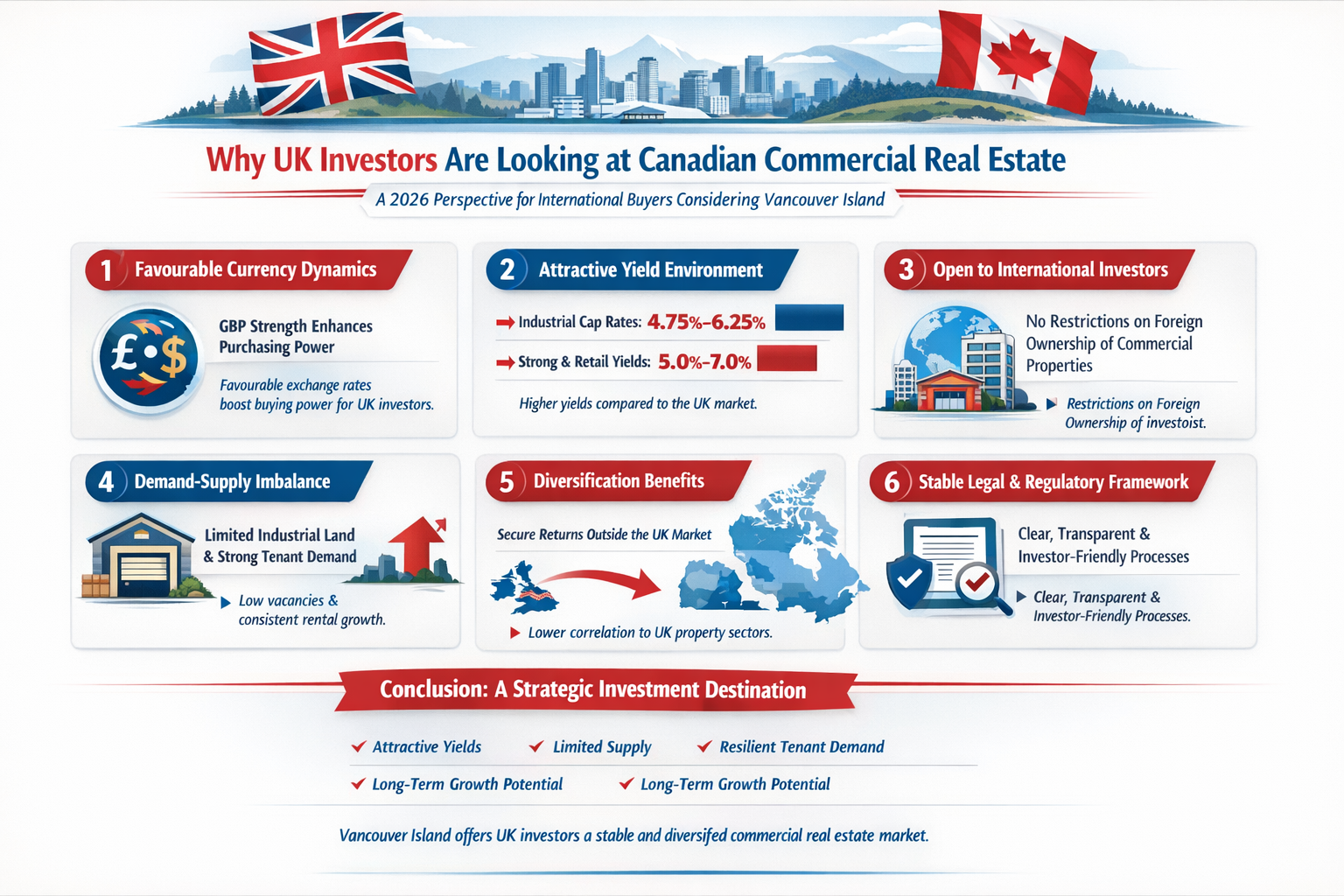
This infographic outlines why UK investors are increasingly allocating capital to Canadian commercial real estate, particularly Vancouver Island. Key drivers include higher yields, favourable currency positioning, and strong demand fundamentals in industrial and service-commercial sectors.

Over the last several years, a growing number of UK-based investors have been reallocating capital into Canadian commercial real estate. The trend is driven by a combination of favourable currency dynamics, the search for yield in a higher-rate UK environment, and Canada’s reputation as a safe, transparent, and institutionally mature market.

Within Canada, Vancouver Island has emerged as a strategic destination due to strong population growth, limited industrial supply, and resilient tenant demand. For UK investors seeking stable cash flow and long-term capital preservation, the region presents a compelling alternative to domestic assets.

This article outlines the structural reasons behind this shift and why Vancouver Island is increasingly on the radar of international buyers.


1. Favourable Currency Dynamics: GBP Strength Enhances Purchasing Power

The relative strength of the British Pound against the Canadian Dollar has made Canadian commercial assets meaningfully more accessible to UK investors. In periods where the GBP trades at a premium to CAD, investors effectively acquire properties at a discount, enhancing both yield and projected returns.

Currency dynamics are not the primary driver of investment decisions, but they improve entry pricing and support total return profiles, especially for income-producing assets.


2. Attractive Yield Environment Compared to the UK

Commercial yields in the UK have compressed over time, particularly in London and major regional centres. Higher financing costs have further pressured leveraged return profiles.

In contrast, Canada—and specifically Vancouver Island—offers:

  • Industrial cap rates between 4.75% and 6.25%

  • Service commercial and small-bay properties often above 5.5%

  • Retail/mixed-use opportunities between 5.0% and 7.0%, depending on tenancy

These yields stand out for international buyers seeking stable, risk-adjusted returns in markets with strong fundamentals and lower tenant turnover.


3. Commercial Real Estate Is Open to International Investors

One of the most significant advantages for overseas investors is that Canada does not restrict foreign ownership of commercial or industrial real estate.
Restrictions apply only to certain residential categories — not to income-producing properties or commercial land.

This regulatory openness provides clarity and accessibility, allowing UK investors to deploy capital efficiently without structural barriers.


4. Vancouver Island’s Demand-Supply Imbalance Favors Investors

Vancouver Island faces a chronic shortage of industrial and service-commercial space due to:

  • Limited land available for industrial zoning

  • Strong and growing population inflows

  • Expansion of logistics, trades, construction, marine, and service industries

  • High tenant retention and extremely low vacancies in several submarkets

This imbalance has historically supported:

  • Consistent rental growth

  • Stable occupancy

  • Appreciation of industrial land values

  • Predictable income streams

Unlike more volatile metropolitan regions, the Island’s growth is steady, diversified, and long-term.


5. Diversification Benefits Beyond the UK Market

Canadian commercial markets behave differently from those in the UK. As a result, Vancouver Island can serve as a diversification tool for global portfolios by offering:

  • Exposure to a different economic cycle

  • A region supported by migration, population growth, and sustained municipal infrastructure investment

  • A lower correlation to UK commercial sectors such as office, retail, and metropolitan multifamily

For investors accustomed to concentrated UK property portfolios, Canada offers a geographically and sectorally differentiated income stream.


6. Transparent Legal & Regulatory Framework

Canada’s transaction and ownership processes are straightforward and investor-friendly:

  • Clear title systems

  • Reliable legal protections

  • Standardized due diligence procedures

  • Widespread use of digital signing, enabling remote transactions

  • Professional ecosystem of lawyers, appraisers, inspectors, and property managers

This transparency is particularly appealing to investors looking for predictability and clean governance.


7. Seamless Remote Ownership & Management Options

For overseas investors, the practicality of managing assets is often a key concern.
Vancouver Island has a strong base of local property managers who provide:

  • Rent collection

  • Tenant communication

  • Repairs and maintenance coordination

  • Financial reporting

  • On-site oversight

This operational support makes foreign ownership feasible and hands-off, even from thousands of miles away.


Conclusion: A Strategic Market for Global Investors

UK investors are increasingly drawn to Canadian commercial real estate for its:

  • Attractive yields

  • Stable regulatory environment

  • Strong fundamentals in industrial and service-commercial sectors

  • Favourable currency positioning

  • Long-term growth outlook

Vancouver Island stands out as a market with structural strengths: limited supply, resilient tenant demand, and steady population growth create a favourable environment for income-focused investors seeking diversification and stability.

For investors evaluating global opportunities, Vancouver Island represents a strategic, well-supported, and institutionally reliable destination to deploy capital.


Read

Why Foundations, Endowments, and Family Offices Should Invest in Nanaimo

A Strategic, Risk-Adjusted Case for Allocating Capital to Vancouver Island’s Rising Commercial Market

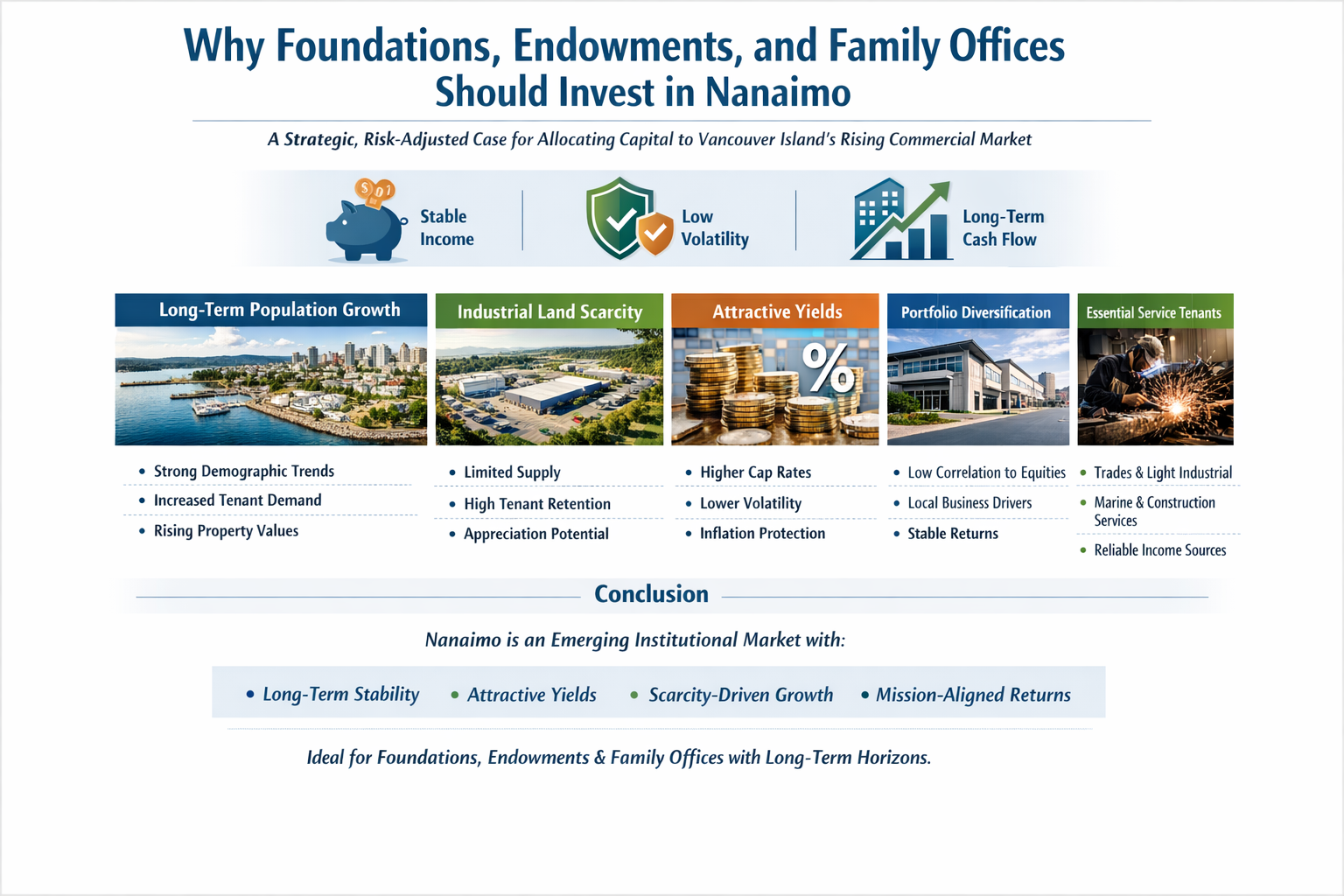
This infographic highlights why Nanaimo is emerging as a compelling commercial real estate market for foundations, endowments, and family offices seeking stable, long-term income. Supported by strong population growth, industrial land scarcity, resilient tenant demand, and ongoing infrastructure investment, the region offers attractive risk-adjusted returns and diversification benefits within a transparent and low-volatility investment environment.

Foundations, endowments, and family offices increasingly seek real estate allocations that offer:

  • Stable income

  • Low volatility

  • Long-duration cash flows

  • Inflation protection

  • Diversification away from traditional equities and fixed income

While major Canadian cities receive most of the capital flows, Nanaimo — the commercial and geographic centre of Vancouver Island — has emerged as a structurally strong and strategically advantageous market for institutional and quasi-institutional investors.

This article outlines why mission-aligned investors with long time horizons should consider Nanaimo as part of a disciplined real estate allocation.


1. Long-Term Population Growth Supports Durable Demand

A core principle of endowment and foundation investment mandates is allocating toward regions with demographic tailwinds.

Nanaimo’s population growth profile is one of the strongest among mid-sized cities in Canada, driven by:

  • Interprovincial migration

  • Migration from Greater Vancouver

  • Influx of retirees, professionals, and skilled trades

  • High quality of life, affordability, and natural amenities

Sustained population growth is a leading indicator of:

  • Higher commercial absorption

  • Stronger tenant demand

  • Improved long-term occupancy stability

  • Rising land and property values

This demographic momentum aligns well with institutional portfolio objectives emphasizing resilience and predictable long-term performance.


2. Structural Industrial Land Scarcity Protects Long-Term Value

Nanaimo’s industrial and service-commercial land base is constrained by:

  • Island geography

  • ALR (Agricultural Land Reserve) restrictions

  • Limited serviced industrial inventory

  • Slow municipal rezoning processes

  • Competition from residential and mixed-use development

This constrained supply creates:

  • Downside protection

  • Strong pricing power

  • High tenant retention

  • Persistent demand for small-bay industrial

  • Long-term appreciation support

For long-duration investors — particularly those with perpetual mandates (foundations/endowments) — scarcity is a critical driver of long-term portfolio stability.


3. Attractive Risk-Adjusted Yields vs Major Canadian Markets

Institutions accept lower yields in cities like Vancouver or Toronto due to scale and liquidity.
However, Nanaimo offers superior risk-adjusted returns because:

  • Cap rates remain 4.75%–6.25% in industrial and service commercial

  • Lease terms are typically 3–5+ years

  • Vacancy remains extremely low

  • Tenant demand is diversified and essential-service oriented

  • Construction costs and land values remain lower than mainland BC

For a foundation or family office seeking stable, inflation-hedged income, Nanaimo offers a compelling balance of:

  • Yield

  • Stability

  • Appreciation potential

  • Lower volatility than equity markets

The market is still early in its growth cycle, offering entry pricing that major cities offered 10–15 years ago.


4. Portfolio Diversification & Low Correlation to Public Markets

Real estate serves a stabilizing function in institutional portfolios due to its low correlation to:

  • Public equities

  • Fixed income

  • Alternative assets with higher volatility

Nanaimo’s commercial markets are driven by:

  • Local business activity

  • Trades and service industries

  • Regional demographics

  • Non-speculative, needs-based tenants

These dynamics create a defensive and predictable return profile, ideal for mission-aligned investors aiming to reduce portfolio volatility.


5. Strong Tenant Fundamentals: Essential Service Demand

Nanaimo’s tenant base is dominated by:

  • Trades and contractors

  • Marine services

  • Construction industry suppliers

  • Light manufacturing and fabrication

  • Equipment operators

  • Automotive and service commercial tenants

These are essential, non-discretionary sectors that remain resilient across economic cycles.

For endowments and foundations aiming to preserve capital while generating stable income, this tenant mix provides:

  • High occupancy stability

  • Low turnover

  • Lower default risk

  • Minimal exposure to cyclical retail or office volatility


6. Infrastructure Expansion Strengthens the Long-Term Investment Thesis

Institutions invest in markets where infrastructure accelerates economic potential.

Nanaimo is currently benefiting from:

  • Airport expansion (YCD)

  • Highway and corridor improvements

  • Growing port and marine activity

  • Upgrades to logistics infrastructure

  • Expansion of commercial hubs in North and South Nanaimo

  • Growth in higher education and healthcare services

Infrastructure upgrades typically precede sustained commercial absorption — a key reason family offices and endowments allocate early.


7. A Market in the Early Stages of Institutional Maturation

Kelowna and Victoria have already undergone major institutional capitalization cycles.
Nanaimo, however, is just entering its institutionalization phase, offering:

  • Early-cycle price advantages

  • Lower competition from institutional buyers

  • Ability to secure high-quality assets before widespread repricing

  • First-mover advantages for family offices

In other words, Nanaimo is where Kelowna and Victoria were 10–15 years ago — with fundamentals aligning for long-term growth.


8. Ideal for Long-Term, Mission-Aligned Capital

Foundations, endowments, and family offices typically seek:

  • Stable cash flow

  • Modest leverage

  • Long-term capital preservation

  • Inflation protection

  • Low operational complexity

Nanaimo’s industrial and service commercial markets align extremely well with these mandates:

  • NNN leases reduce operational burden

  • Industrial tenants are sticky and location-dependent

  • Land scarcity creates long-term appreciation pressure

  • Cash flows are predictable and inflation-aligned

This makes Nanaimo highly suitable for perpetual capital structures.


Conclusion

Nanaimo represents one of the most strategically compelling commercial real estate markets in Western Canada for foundations, endowments, and family offices seeking:

  • Long-duration stability

  • Attractive yields

  • Low volatility

  • Scarcity-driven appreciation

  • Strong demographic and economic fundamentals

With sustained population growth, industrial land constraints, diversified tenant demand, and improving infrastructure, Nanaimo is positioned to deliver resilient, mission-aligned returns for sophisticated investors with long-term horizons.


Read

Why Nanaimo Today Resembles Kelowna 10–15 Years Ago: A High-Growth Market in the Making

A Comparative Analysis for Commercial and Industrial Investors

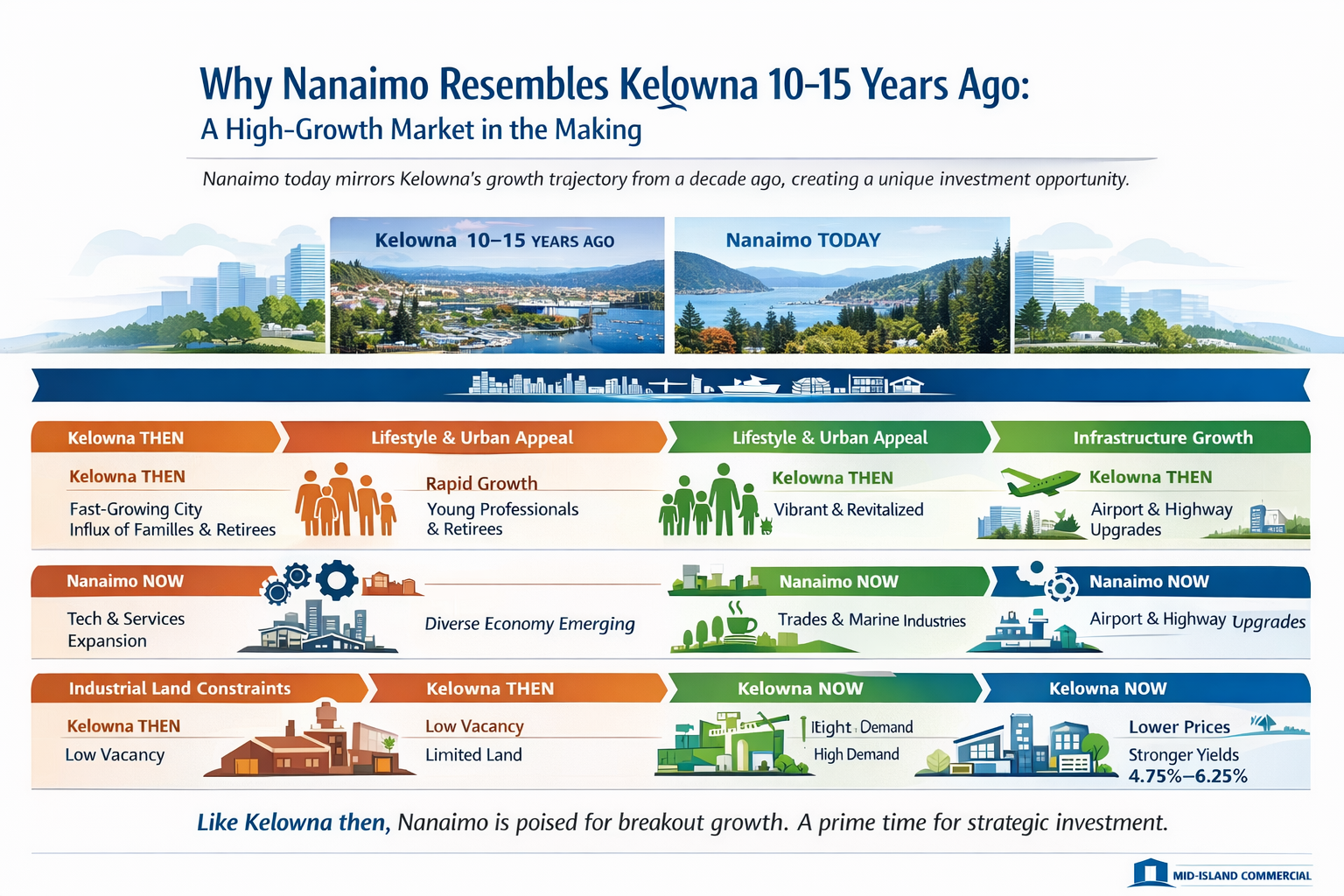
This infographic explores the strong parallels between Nanaimo today and Kelowna 10–15 years ago, highlighting key drivers such as population growth, lifestyle migration, economic diversification, and constrained industrial land supply. With infrastructure expansion and increasing investor activity, Nanaimo is positioned in an early stage of its growth cycle, offering attractive entry points and long-term upside for commercial and industrial real estate investors.


Kelowna is widely recognized as one of Canada’s most successful mid-sized city growth stories. Over the last decade, the region has experienced significant appreciation in residential, commercial, and industrial real estate, driven by population growth, economic diversification, constrained land supply, and lifestyle-driven migration.

Increasingly, investors are observing that Nanaimo today mirrors Kelowna’s profile from 10–15 years ago. From demographic trends to economic drivers, land scarcity, and commercial demand, the similarities are striking — but Nanaimo still remains in an earlier, more accessible phase of its growth cycle.

This article outlines the key parallels and explains why Nanaimo is positioned to follow a similar trajectory.


1. Population & Migration Trends: An Echo of Kelowna’s Growth Surge

Kelowna (10–15 Years Ago)

  • One of Canada’s fastest-growing cities

  • Strong inflow of young families, remote workers, and retirees

  • Significant interprovincial migration

  • Rapid suburban expansion and new neighbourhood growth

Nanaimo (Today)

  • Among BC’s fastest-growing mid-sized cities

  • Attracting a similar mix of:

    • Young professionals

    • Trades and skilled labour

    • Remote workers

    • Retirees

  • Growth accelerating in North Nanaimo, South Nanaimo, and surrounding regional districts

Key Insight:
Demographics were a major catalyst for Kelowna’s real estate boom — and Nanaimo is on the same trajectory.


2. Lifestyle-Driven Demand & Emerging Urban Appeal

Kelowna (10–15 Years Ago)

  • Began transitioning from a seasonal/tourism market to a year-round lifestyle and employment hub

  • Increased interest from Greater Vancouver migrants

  • Growth of culture, dining, and urban amenities

Nanaimo (Today)

  • Experiencing similar transformation:

    • More amenities, restaurants, and urban renewal

    • Downtown revitalization activity

    • Strong appeal to Vancouver residents seeking affordability and quality of life

  • Increasingly viewed as a balanced lifestyle + opportunity destination

Key Insight:
Lifestyle migration was a major driver of Kelowna’s growth — and Nanaimo is attracting the same demographic profile.


3. Economic Diversification Patterns: Nanaimo Is Following Kelowna’s Path

Kelowna (10–15 Years Ago)

  • Expanded beyond tourism into:

    • Tech

    • Professional services

    • Healthcare

    • Construction

    • Education and research

  • Saw a surge in entrepreneurship and small businesses

Nanaimo (Today)

  • Now experiencing similar diversification:

    • Rapid growth in construction and trades

    • Expansion of healthcare and education

    • More professional services

    • Growth in marine, logistics, and supporting industries

    • Increased entrepreneurship and small business formation

Key Insight:
As Kelowna diversified, commercial and industrial demand surged — Nanaimo is at this inflection point now.


4. Industrial & Commercial Supply Constraints: A Familiar Pattern

Kelowna (10–15 Years Ago)

  • Limited industrial land due to geography and zoning

  • Strong demand from growing trades and service industries

  • Industrial vacancy compressed significantly

  • Land values climbed steadily

Nanaimo (Today)

Shows the same supply-demand imbalance:

  • Severe shortage of industrial land

  • High tenant retention for industrial and service-commercial properties

  • Scarce small-bay industrial inventory

  • Strong demand from construction, trades, equipment operators, and marine-related tenants

Key Insight:
Industrial scarcity was the foundation of Kelowna’s commercial appreciation — Nanaimo’s long-term supply constraints signal similar upward potential.


5. Infrastructure Investment: Nanaimo’s Expansion Mirrors Kelowna’s Past Cycle

Kelowna's Growth Phase

  • Airport expansion (YLW) transformed connectivity

  • New commercial nodes and retail hubs emerged

  • Major road and corridor improvements

Nanaimo Today

  • Airport expansion (YCD) and more destinations

  • Highway and corridor upgrades improving regional movement

  • South and North Nanaimo evolving into major commercial centres

  • Marine, ferry, and logistics infrastructure strengthening

Key Insight:
Infrastructure investment preceded Kelowna’s rise — Nanaimo is now entering a similar acceleration phase.


6. Pricing & Yield Comparison: Nanaimo Is Earlier in the Value Curve

Kelowna Today

  • Industrial and commercial pricing has appreciated significantly

  • Cap rates compressed due to competition and low supply

  • Owner-user demand pushes pricing beyond many private investors

Nanaimo Today

  • Still offers:

    • Lower entry pricing

    • More favourable yields (4.75%–6.25%)

    • Stronger risk-adjusted return potential

  • Market still accessible for private and international buyers

Key Insight:
Nanaimo is at a point similar to Kelowna’s “pre-breakout” phase — offering better upside and more accessible entry.


7. Investor Behaviour: Early Accumulation Phase in Nanaimo

Kelowna’s Early Cycle (10–15 Years Ago)

  • Private investors began accumulating industrial strata

  • Developers targeted service-commercial and mixed-use projects

  • Owner-users increased demand for industrial land

Nanaimo Now

  • Similar patterns:

    • Growing competition for small-bay industrial

    • More owner-users entering early

    • Increased developer interest

    • Early-stage land banking strategies emerging

Key Insight:
The same early signals seen in Kelowna’s growth cycle are appearing now in Nanaimo.


Conclusion

Although every market is unique, the parallels between Nanaimo today and Kelowna 10–15 years ago are compelling. Both cities share:

  • Strong population growth

  • Lifestyle-driven migration

  • Expanding economic diversification

  • Chronic industrial land shortages

  • Infrastructure investment

  • Growing business and service ecosystems

Kelowna’s trajectory offers a useful blueprint for understanding Nanaimo’s long-term potential. As Nanaimo continues its transformation, its commercial and industrial markets offer attractive opportunities for investors seeking early entry into a rising regional hub.


Read

What Businesses Should Know Before Leasing Industrial Space in Nanaimo

For many businesses, leasing industrial space is a critical step in growth. Whether expanding operations, relocating a warehouse, or securing yard space, the process involves more than simply comparing rental rates.

In Nanaimo and across the Mid-Island corridor, limited industrial inventory means tenants must often make decisions quickly while still evaluating long-term operational needs.

This guide outlines several key considerations for businesses evaluating industrial lease opportunities.

This infographic outlines the key considerations for businesses leasing industrial space in Nanaimo, including lease structures, zoning requirements, space functionality, and cost components such as base rent and additional rent. With limited supply and strong demand across the industrial market, understanding these factors is essential for securing suitable space and negotiating favourable lease terms.

1. Understand Your Operational Requirements

Before beginning a search, businesses should clearly define their operational needs. Important factors include:

  • Required square footage

  • Ceiling height and loading access

  • Office versus warehouse allocation

  • Yard storage requirements

  • Parking and vehicle circulation

Industrial buildings vary widely in functionality. A space that appears suitable on paper may not accommodate operational needs once equipment layouts and workflow are considered.


2. Loading and Access Matter More Than You Think

Loading infrastructure is often overlooked during the early stages of a search.

Key questions include:

  • Does the property offer grade loading or dock loading?

  • Can delivery trucks easily maneuver on site?

  • Is there sufficient space for larger vehicles?

In Nanaimo, many smaller industrial buildings were designed decades ago and may have limitations around modern loading requirements.


3. Consider Future Growth

Many businesses sign leases based only on their current needs.

However, relocation can be disruptive and expensive. Businesses should consider whether the space will accommodate expansion over the next several years.

This may involve:

  • Securing additional storage space

  • Negotiating expansion options

  • Choosing locations with additional nearby availability

Planning ahead can reduce the risk of needing another move within a short period of time.


4. Lease Structure and Additional Costs

Industrial leases typically include several components beyond the base rent.

Tenants should carefully review:

  • Base rent

  • Additional rent (operating costs, taxes, insurance)

  • Utility responsibilities

  • Tenant improvement allowances

  • Maintenance obligations

Understanding the full occupancy cost is essential when comparing different properties.


5. Market Conditions in Nanaimo

Industrial vacancy in Nanaimo remains limited compared with larger metropolitan markets.

Because of this, well-located industrial spaces — particularly those under 5,000 square feet or with yard capability — can lease quickly.

Businesses searching for space may benefit from working with a broker who actively tracks available inventory and upcoming opportunities.


Final Thoughts

Leasing industrial space is both an operational and financial decision. By carefully evaluating operational requirements, lease terms, and long-term growth plans, businesses can secure space that supports their continued expansion.

Read

Mid-Island Industrial Market Outlook – 2026

Nanaimo Industrial Real Estate Remains Structurally Constrained

Industrial vacancy across Nanaimo and the broader Mid-Island corridor remains limited entering 2026. While broader economic conditions have moderated across Canada, Vancouver Island’s industrial market continues to be defined by one core reality:

There is very little new supply.

This outlook reviews current supply conditions, lease rate trends, industrial land availability, and what it means for investors and owner-operators.


1. Nanaimo’s Industrial Market Is Structurally Different

Unlike Metro Vancouver, Nanaimo does not experience large waves of speculative industrial development. New projects are typically:

  • Small-bay strata industrial

  • Build-to-suit facilities

  • Phased developments tied to end users

  • Owner-driven construction

Flat, serviceable industrial land is limited. Expansion corridors are constrained. Infrastructure timelines are meaningful.

The result:
Inventory depth remains thin even during slower economic periods.


2. Industrial Vacancy Remains Low

Vacancy across Nanaimo remains tight by historical standards, particularly for:

  • Units under 5,000 SF

  • Functional warehouse with grade loading

  • Secured yard space

  • Highway-accessible locations

Because the market is relatively small, even modest absorption can materially impact availability.

Unlike larger markets, vacancy here does not spike dramatically — simply because there isn’t enough speculative inventory to create oversupply.

For landlords, this has supported stable occupancy levels.

For tenants, it reinforces the importance of proactive planning.


3. Lease Rates: Holding Firm

Industrial lease rates across Nanaimo have trended upward in recent years, supported by:

  • Higher construction costs

  • Rising land values

  • Limited new supply

  • Strong local business demand

The most competitive segment remains small-bay industrial and yard-oriented product.

Tenant demand continues to come from:

  • Trades and construction companies

  • Marine and transportation operators

  • Logistics and service industrial users

  • Regional distribution businesses

While broader economic normalization may temper aggressive rent growth, significant rate declines appear unlikely absent a supply shock.


4. Industrial Land: The True Constraint

Serviced industrial land remains the most supply-constrained segment of the Mid-Island market.

Challenges include:

  • Limited subdivision activity

  • Infrastructure servicing timelines

  • Zoning limitations

  • Lengthy development approvals

Users seeking expansion are often faced with:

  • Limited options

  • Higher per-acre pricing

  • Longer development horizons

This scarcity supports long-term land value stability.


5. What This Means for 2026

For Owner-Operators

  • Purchasing can provide long-term cost certainty

  • Build-to-suit projects require early engagement

  • Securing yard-capable sites is increasingly competitive

For Investors

  • Small-bay industrial remains liquid

  • Long-term hold strategies align with regional growth

  • Older inventory may present repositioning opportunities

  • Scarcity continues to support valuations

The Mid-Island industrial market is not driven by speculative cycles. It is driven by land constraints and steady regional demand.


Final Thoughts

Entering 2026, Nanaimo’s industrial market remains fundamentally supply-limited. While broader economic conditions warrant caution, structural constraints continue to support occupancy stability and long-term asset value.

For investors and business owners evaluating opportunities across Nanaimo and the Mid-Island corridor, disciplined acquisition and proactive planning remain key advantages.

Read
MLS® property information is provided under copyright© by the Vancouver Island Real Estate Board and Victoria Real Estate Board. The information is from sources deemed reliable, but should not be relied upon without independent verification.