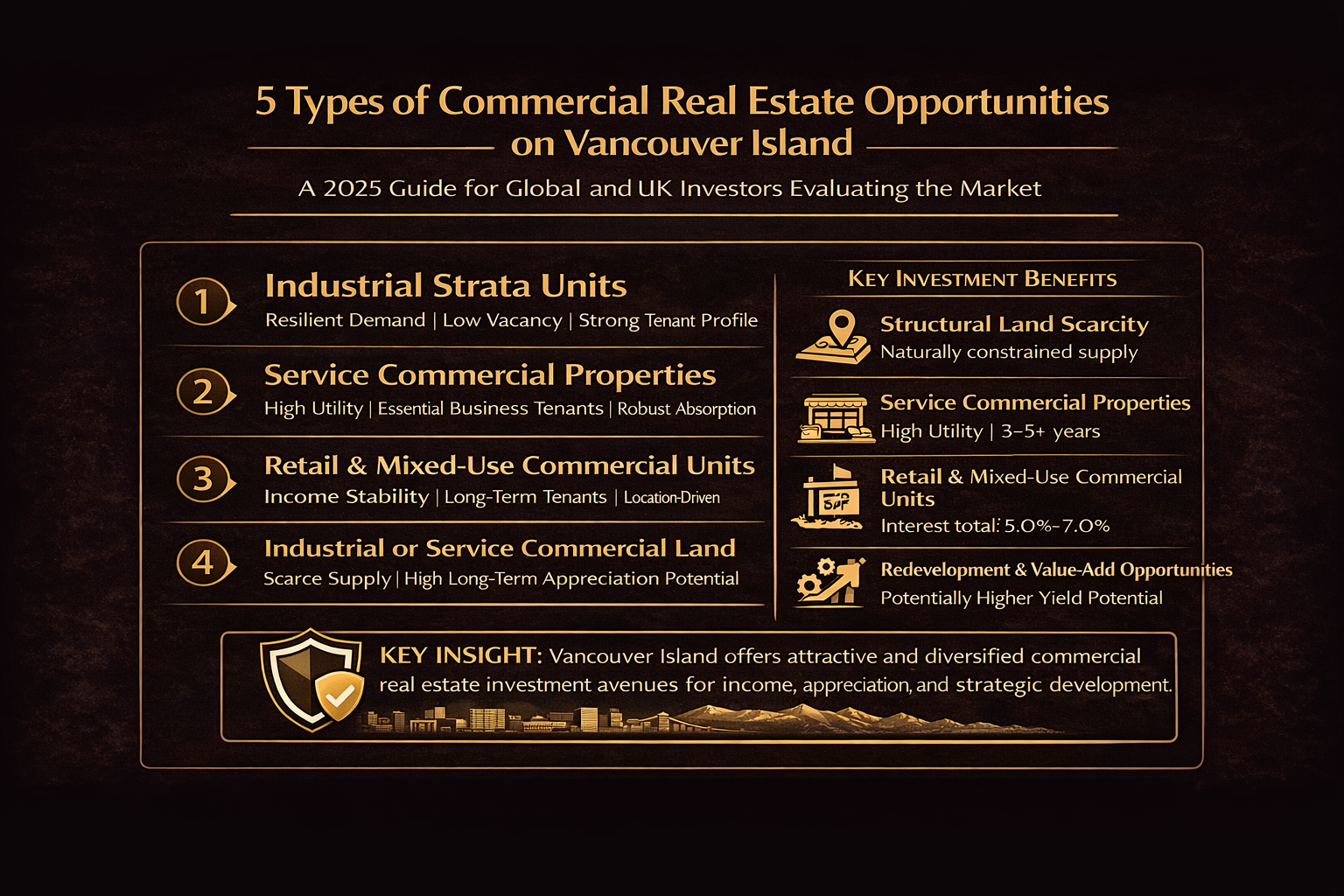
Understanding the Growth Patterns, Fundamentals, and Investment Signals

Over the last decade, Victoria has transformed from a stable government-and-tourism-driven city into one of the most dynamic mid-sized economies in Canada. Its industrial and commercial markets have experienced significant appreciation, driven by population inflows, constrained land supply, municipal development initiatives, and the rise of knowledge-based industries.
Increasingly, investors are recognizing that Nanaimo today resembles Victoria 10–15 years ago — not only in growth trajectory, but also in demographic, economic, and infrastructural patterns. With rapid expansion, improved connectivity, and strong regional positioning, Nanaimo is becoming the island’s next major commercial hub.
This article outlines the structural parallels between the two cities and explains why Nanaimo is poised to follow a similar long-term growth path.
1. Population Growth Trends: Nanaimo Today Mirrors Victoria a Decade Ago
Victoria (10–15 years ago)
Began experiencing above-average population growth
Strong migration from Greater Vancouver and other provinces
Increasing inflow of young professionals
Lifestyle-driven relocation and retirement trends
Nanaimo (Today)
One of the fastest-growing mid-sized cities in Canada
Strong interprovincial migration
Attracting young families, remote workers, and trades professionals
Significant expansion in suburban areas and the regional district
Key Insight:
Nanaimo’s demographic profile closely mirrors Victoria’s pre-boom period — a foundational signal for long-term commercial and industrial demand.
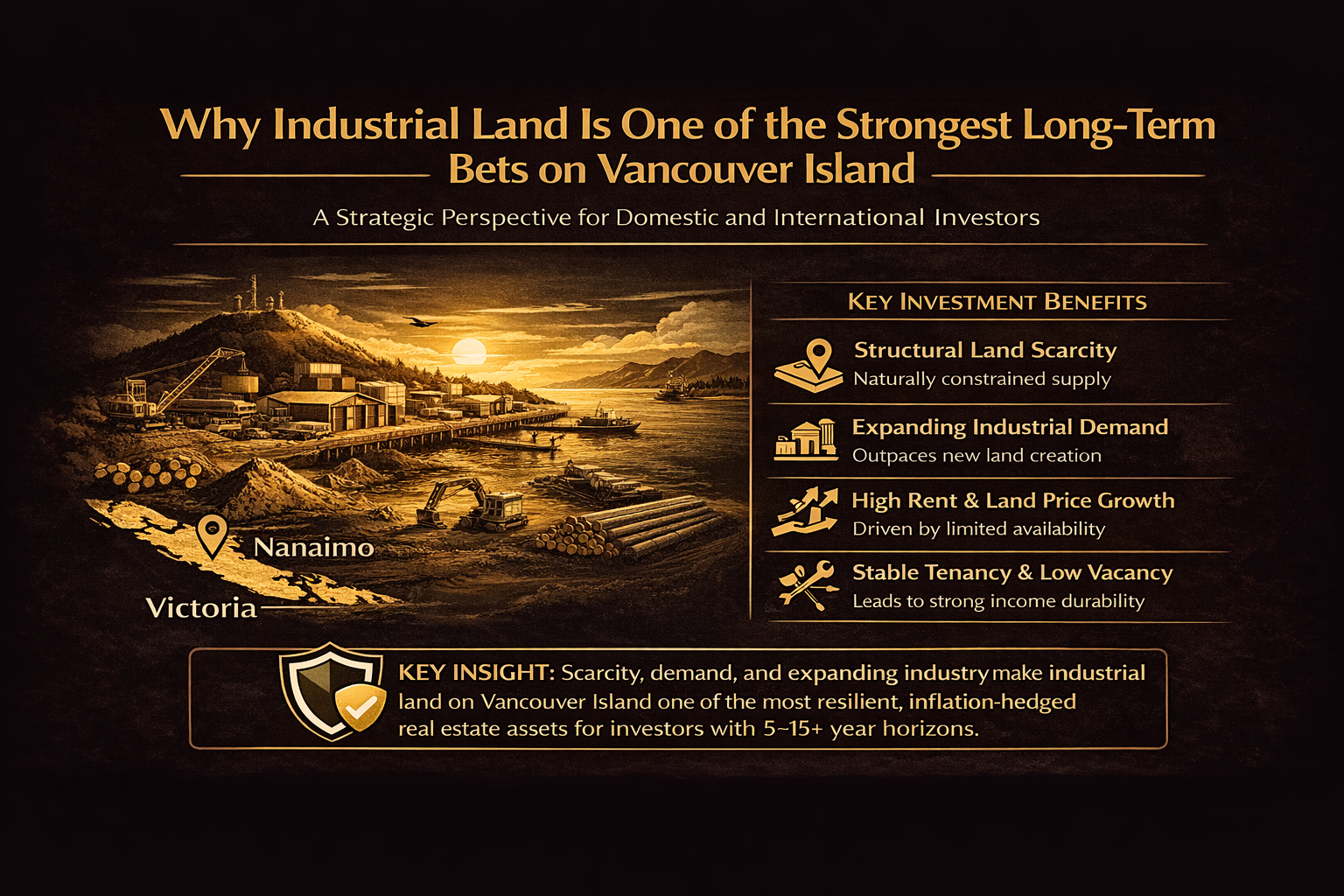
2. Land Scarcity Dynamics: A Repeat of Victoria’s Supply Constraints
Victoria (10–15 years ago)
Limited industrial land due to geography and zoning
Aging industrial parks with little new supply
Rising pressure from residential developers
Sharp increase in industrial rents and land values
Nanaimo (Today)
Similar geographic constraints with mountains, water boundaries, and ALR
Limited industrial land inventory and few large parcels
Strong competing pressures for mixed-use and residential development
Industrial rental growth accelerating faster than supply
Key Insight:
Victoria’s industrial scarcity drove long-term asset appreciation.
Nanaimo’s land constraints position it for similar upward pressure over the next decade.
3. Infrastructure Investment: Nanaimo Is Entering Its Expansion Phase
Victoria (10–15 years ago)
Major upgrades to transportation and municipal infrastructure
Expansion of tech and innovation districts
Growth in academic institutions (e.g., UVic’s larger role)
Nanaimo (Today)
Significant infrastructural improvements are underway or recently completed:
Highway upgrades and improved corridor connectivity
Port expansion and increased marine industry activity
Nanaimo Airport (YCD) upgrades and expanded flight routes
Rapid growth around Woodgrove, North Nanaimo, South Nanaimo
Strengthening regional retail and service hubs
These investments typically precede commercial absorption, just as they did in Victoria.
4. Economic Diversification: Nanaimo’s Growth Curve Is Following Victoria’s Lead
Victoria (10–15 years ago)
Evolved from a government-dominated economy to include:
Tech and innovation
Education
Health care expansion
Professional services
Construction and trades
Nanaimo (Today)
Now experiencing similar diversification:
Expanding construction and trades ecosystem
Marine and logistics sector growth
Strengthening healthcare and education presence
Increased small-business formation
Emerging interest from tech, remote workers, and service industries
Key Insight:
Economic diversification was a pivotal turning point for Victoria — and Nanaimo is following the same pattern.
5. Commercial and Industrial Demand: Echoes of Victoria’s Earlier Cycle
Victoria (10–15 years ago)
Industrial vacancy fell below 2%
Owner-users began purchasing assets aggressively
Rents increased as supply dried up
Land values rose sharply
Small-bay industrial became one of the strongest-performing asset classes
Nanaimo (Today)
Small-bay industrial is already in high demand
Vacancy remains extremely low
Owner-users and trades are competing for limited supply
Industrial strata launching at higher rent expectations each year
Land values showing consistent upward pressure
Key Insight:
These indicators match Victoria’s early-cycle signals almost exactly — suggesting sustained performance ahead.
6. Location as a Regional Hub: Nanaimo’s Natural Advantage
Victoria’s Regional Role
Served as a South Island hub, drawing commuters and businesses from surrounding communities.
Nanaimo’s Positioning Today
The geographic centre of Vancouver Island
Ideal distribution point for north-south corridors
Serves as a regional retail and services hub
Ferry connections to the mainland strengthen logistics capability
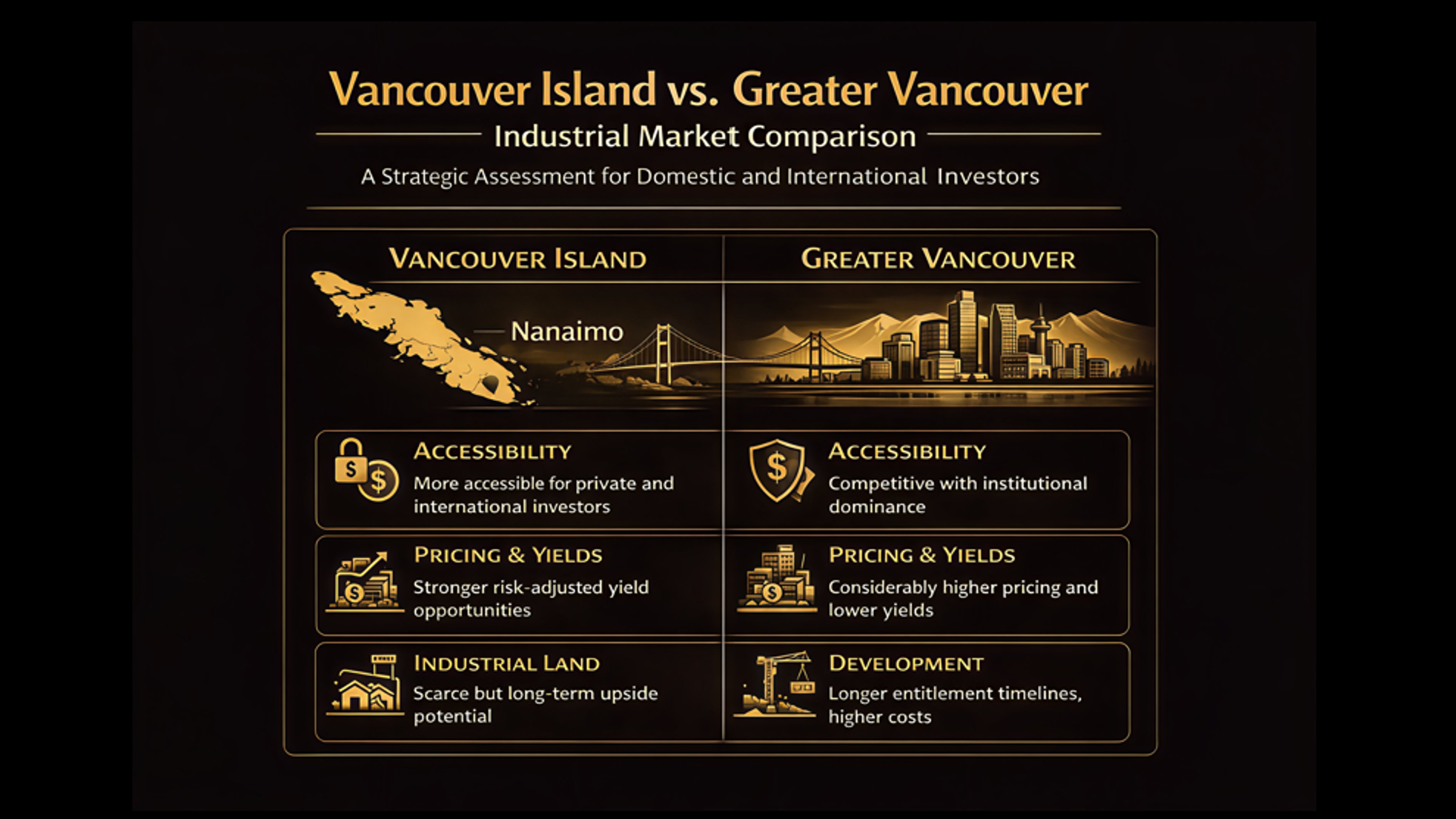
Attracts users priced out of Greater Vancouver industrial markets
Nanaimo is now becoming the central commercial and industrial nexus that links North Vancouver Island, the Cowichan Valley, and the mid-Island region.
7. Investor Sentiment: Early-Stage Accumulation Phase
Victoria (10–15 years ago)
Sophisticated investors entered early, recognizing long-term structural advantages.
Nanaimo (Today)
Private investors, owner-users, and selective institutions are beginning to:
Acquire industrial strata units
Buy and hold service-commercial land
Pursue redevelopment opportunities
Enter long-term land-banking strategies
These moves mirror early investor behaviour seen in Victoria’s pre-growth phase.
Conclusion
Nanaimo exhibits many of the same characteristics that fueled Victoria’s transformation over the past decade: population growth, land scarcity, diversified economic expansion, infrastructure investment, and increasing commercial and industrial demand.
While the city is earlier in its growth cycle compared to Victoria, the parallels are clear — and compelling. For investors seeking long-term stability and strategic positioning in Western Canada, Nanaimo represents a rising market with strong fundamentals and an upward trajectory.