

Vancouver Island has become one of Canada’s most compelling destinations for commercial real estate investment. With sustained population growth, extremely limited industrial supply, and strong tenant demand, the region offers investors a clear path to stable income and long-term capital preservation.
For UK and international investors evaluating opportunities in North America, understanding the types of commercial assets available on Vancouver Island is essential. This guide outlines five key categories, their core characteristics, and the strategic considerations behind each.
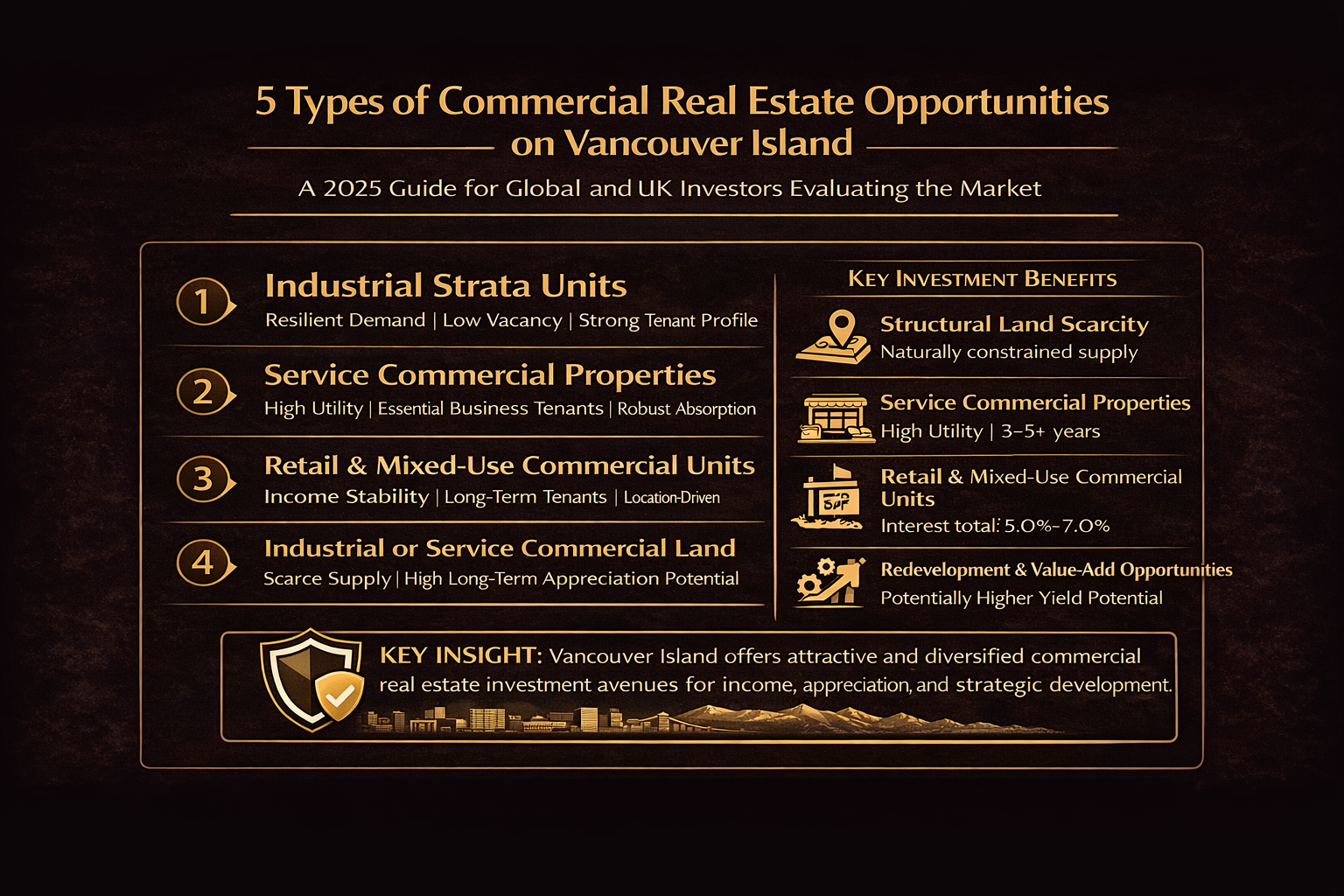
1. Industrial Strata Units
Resilient Demand | Low Vacancy | Strong Tenant Profile
Industrial strata units—typically 1,500 to 5,000 sq. ft.—represent one of the most stable and sought-after investment types on Vancouver Island.
Why investors like them:
Historically low vacancy, often near 0% in certain submarkets
Strong demand from trades, logistics, light manufacturing, storage operators, and service companies
Predictable cash flows due to long-term tenants and modest turnover
Limited new supply due to zoning constraints
Minimal capital expenditures compared to older industrial stock
Typical metrics:
CAP rates: 4.75% to 6.0%, depending on age, tenancy, and location
Lease terms: 3–5+ years, often with renewal options
Tenant improvements: modest compared to office or retail
Who this is ideal for:
Investors seeking stable income, simplicity, and low-maintenance ownership.
2. Service Commercial Properties
High Utility | Essential Business Tenants | Robust Absorption
Service commercial assets include properties used by automotive services, contractors, equipment rental companies, specialty repair shops, and other essential services.
Why they perform well:
High tenant retention due to location-specific operational needs
Strong absorption driven by growing population and trades industries
Often higher yields than newer industrial strata
Consistent demand in both economic expansions and slowdowns
Typical metrics:
CAP rates: 5.25% to 6.5%
Tenant type: Local businesses with stable revenue profiles
Lease terms: Often 3–5 years, sometimes longer
Who this is ideal for:
Income investors seeking a higher-yielding alternative to traditional industrial assets.
3. Retail and Mixed-Use Commercial Units
Income Stability | Long-Term Tenants | Location-Driven Performance
Retail strata units and mixed-use commercial spaces (main floor retail with residential above) continue to attract investors looking for balanced yield and tenant diversification.
Key drivers:
Long-term tenancy from essential services (food, wellness, personal services, clinics)
Steady consumer demand due to strong residential growth on the Island
Often located in walkable, central areas with limited new supply
Opportunity for investors to underwrite a variety of tenant types
Typical metrics:
CAP rates: 5.0%–7.0%, depending on location and covenant
Tenants: Restaurants, medical/dental, retail services, boutique operators
Capex: Moderate depending on tenant improvements
Who this is ideal for:
Investors comfortable evaluating tenant covenant strength and looking for a mix of income and appreciation.
4. Industrial or Service Commercial Land
Scarce Supply | High Long-Term Appreciation Potential
Industrial land is one of the most constrained asset classes on Vancouver Island. Due to geography, zoning restrictions, and limited greenfield availability, well-located parcels often experience consistent long-term appreciation.
Why it’s attractive:
Extremely limited supply relative to demand
Useful for land banking, build-to-suit opportunities, or redevelopment
Strong appreciation in high-growth areas like Nanaimo and Langford
Flexible strategies: hold, develop, or lease as yard space (where permitted)
Typical metrics:
Pricing varies significantly by location and zoning
Returns driven by appreciation or development strategy
Leasing potential for storage, contractors, or equipment yards (subject to zoning)
Who this is ideal for:
Long-term strategic investors focused on appreciation, development potential, or build-to-suit projects.
5. Redevelopment & Value-Add Opportunities
Strategic Upside | Planning-Driven Value | Localized Scarcity
Select properties on Vancouver Island offer value through repositioning, densification, or operational improvements. These opportunities require deeper analysis and execution discipline.
Common strategies:
Re-tenanting to improve NOI
Enhancing lease structure or term
Adding service bays or modifying layouts
Pursuing rezoning or redevelopment opportunities
Improving property management efficiencies
Why investors consider them:
Potentially higher returns than stabilized assets
Ability to unlock value not currently reflected in market pricing
Strategic fit for investors with development or operational expertise
Who this is ideal for:
Investors with appetite for complexity and medium-term value creation.
Conclusion: A Structurally Strong Market for Long-Term Investors
With its combination of population growth, industrial scarcity, and diversified economic activity, Vancouver Island continues to present well-supported opportunities across multiple commercial asset classes. Whether investing for income, diversification, long-term appreciation, or strategic development, the region’s fundamentals provide a compelling foundation for disciplined capital deployment.
For UK and international investors evaluating global alternatives, Vancouver Island offers a unique blend of stability, transparency, and growth potential.
