
A Strategic Perspective on Supply Constraints, Demand Drivers, and Long-Term Value
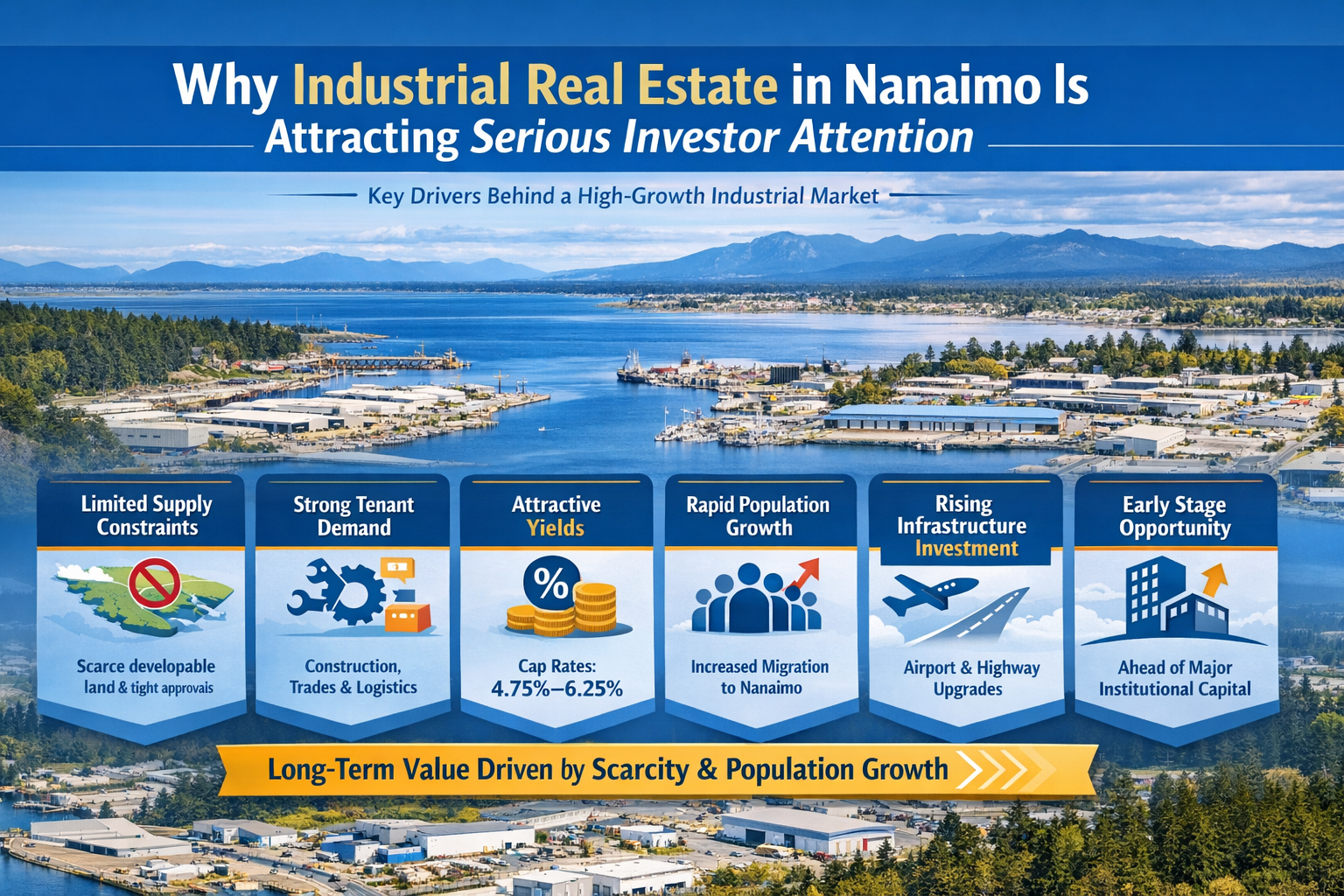
Industrial real estate across Canada has emerged as one of the most resilient asset classes over the past decade. While major markets such as Vancouver and Toronto have seen significant price appreciation and yield compression, smaller regional markets are increasingly drawing investor attention.
Nanaimo, located on Vancouver Island, is one such market. With strong population growth, constrained industrial land supply, and increasing demand from essential service industries, Nanaimo is beginning to exhibit characteristics typically associated with early-stage, high-growth industrial markets.
This article outlines the structural factors driving interest in Nanaimo’s industrial sector and why investors are increasingly allocating capital to the region.
1. Structural Supply Constraints Limit New Industrial Development
One of the defining characteristics of Nanaimo’s industrial market is limited land availability.
Several structural factors restrict new supply:
Island geography limits expansion
Agricultural Land Reserve (ALR) protections reduce developable land
Limited serviced industrial inventory
Lengthy zoning and approval processes
Competing demand from residential and mixed-use development
Unlike larger mainland markets, supply cannot easily respond to increased demand. This creates a structural imbalance that supports:
Long-term land value appreciation
Downside protection during economic cycles
Strong pricing power for landlords
For investors, constrained supply is one of the most important drivers of durable value.
2. Strong and Diverse Tenant Demand
Nanaimo’s industrial demand is driven by essential, non-discretionary sectors, including:
Construction and trades
Marine services
Equipment and logistics operators
Light manufacturing
Automotive and service-commercial users
These businesses are:
Locally embedded
Operationally necessary
Less sensitive to economic volatility
This results in:
High occupancy levels
Strong tenant retention
Lower default risk compared to office or discretionary retail
From an investment perspective, this tenant profile supports stable and predictable income streams.
3. Small-Bay Industrial Is in Particularly High Demand
A notable feature of Nanaimo’s market is the scarcity of small-bay industrial units.
These spaces are highly sought after by:
Local trades businesses
Contractors
Service operators
Owner-users
Key characteristics:
Units typically range from 1,000–5,000 sq. ft.
Limited new supply entering the market
High competition among tenants and buyers
As a result:
Vacancy rates remain extremely low
Lease rates have shown consistent upward pressure
Owner-user demand often competes directly with investors
This segment represents one of the most active and competitive areas within the local industrial market.
4. Attractive Risk-Adjusted Yields Compared to Major Markets
While yields in core markets have compressed significantly, Nanaimo continues to offer:
Industrial cap rates in the range of 4.75%–6.25%
Lower entry pricing compared to Greater Vancouver
Less institutional competition
Importantly, these returns are supported by:
Stable tenant demand
Long-term lease structures
Inflation-linked rent adjustments
For investors seeking a balance of income, stability, and growth, Nanaimo provides a compelling alternative to more saturated markets.
5. Population Growth Is Driving Long-Term Commercial Demand
Nanaimo is one of the fastest-growing mid-sized cities in British Columbia.
Key drivers include:
Migration from Greater Vancouver
Interprovincial migration
Growth in remote work
Lifestyle-driven relocation
Population growth directly impacts industrial demand through:
Increased need for local services
Expansion of trades and construction activity
Growth in logistics and distribution
Over time, these trends support:
Higher absorption of industrial space
Increased rental demand
Sustained pressure on limited supply
6. Infrastructure Investment Is Strengthening the Market
Infrastructure expansion plays a critical role in long-term real estate performance.
Nanaimo is currently benefiting from:
Airport expansion (YCD)
Highway and corridor upgrades
Growth in port and marine activity
Expansion of commercial nodes in North and South Nanaimo
Improved infrastructure enhances:
Connectivity
Business activity
Regional economic integration
Historically, these investments tend to precede sustained commercial growth cycles.
7. A Market in the Early Stages of Institutional Recognition
Markets such as Kelowna and Victoria have already undergone significant institutional investment cycles.
Nanaimo, by contrast, is:
Earlier in its growth trajectory
Less saturated by institutional capital
Still accessible to private and international investors
This creates an opportunity to:
Acquire assets at relatively favourable pricing
Benefit from future yield compression
Participate in long-term market maturation
In many ways, Nanaimo today resembles where other successful regional markets were 10–15 years ago.
Conclusion
Nanaimo’s industrial real estate market is supported by a combination of:
Structural supply constraints
Strong and diversified tenant demand
Attractive risk-adjusted yields
Sustained population growth
Ongoing infrastructure investment
Together, these factors create a stable and forward-looking investment environment.
For investors seeking long-term income, capital preservation, and exposure to a growing regional market, Nanaimo represents a compelling opportunity within Canada’s commercial real estate landscape.
Frequently Asked Questions
What types of industrial properties are available in Nanaimo?
Nanaimo offers a mix of small-bay industrial units, warehouse space, service-commercial buildings, and limited industrial land opportunities.
What are typical industrial cap rates in Nanaimo?
Industrial cap rates generally range between 4.75% and 6.25%, depending on tenant quality, lease terms, and location.
Why is industrial land scarce in Nanaimo?
Supply is constrained due to island geography, Agricultural Land Reserve (ALR) restrictions, and limited serviced industrial zoning.
Is Nanaimo a good market for industrial investment?
Yes, strong population growth, low vacancy, and limited supply make Nanaimo an attractive long-term industrial market.
