

Industrial land has become one of the most compelling long-term investment opportunities on Vancouver Island. With strong demand drivers, chronic land scarcity, and a rapidly expanding industrial user base, the region presents a unique environment where industrial land consistently outperforms traditional commercial asset classes.
For investors — particularly those with multi-year horizons or an interest in strategic land banking — Vancouver Island offers a structurally advantaged market with limited downside risk and meaningful appreciation potential.
This article outlines the fundamental forces that make industrial land one of the strongest long-term real estate plays in the region.
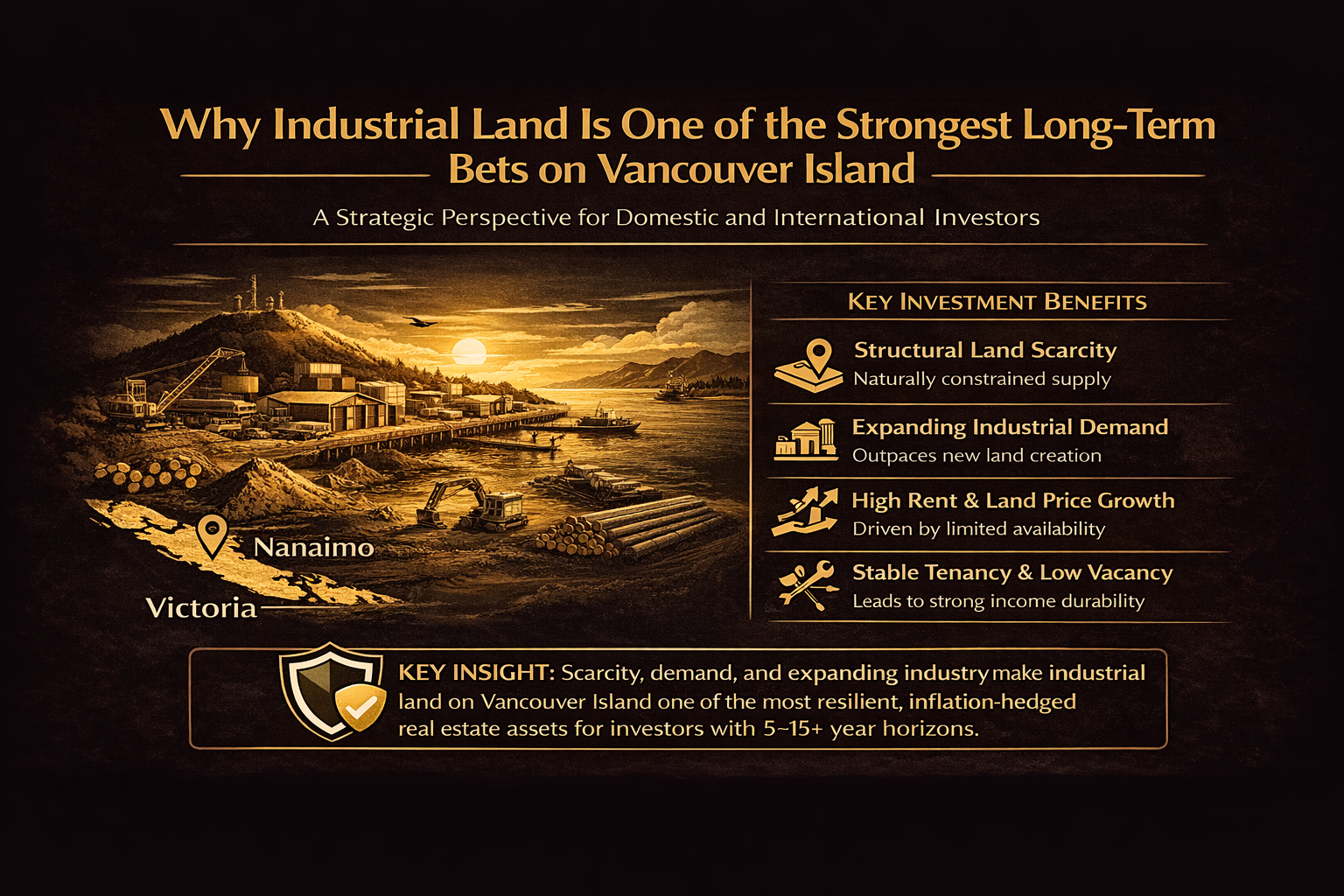
1. Structural Land Scarcity Creates Long-Term Value Protection
Unlike many North American markets with abundant industrial land, Vancouver Island faces natural, political, and geographic constraints that severely limit future supply:
Island geography (finite landmass)
ALR (Agricultural Land Reserve) protections
Limited flat topography suitable for industrial uses
Long municipal planning and rezoning timelines
Competition from residential and mixed-use development
The result is a persistently constrained supply pipeline, where new industrial land rarely enters the market.
This structural scarcity acts as a long-term value stabilizer, supporting predictable appreciation over multi-year periods.
2. Industrial Demand Is Expanding Faster Than New Supply
Multiple industries are driving strong and sustained demand for industrial-zoned land:
Construction and trades
Logistics and distribution
Marine and port-related services
Automotive services
Fabrication and light manufacturing
Equipment storage and contractor yards
Technology, film, and specialty production
Vancouver Island’s population continues to grow above the national average, further accelerating demand for services that depend on industrial land.
In most submarkets, demand significantly exceeds available supply, creating upward pressure on both lease rates and land values.
3. Exceptional Tenant Retention and Low Vacancy Rates
Industrial tenants — particularly trades, contractors, marine operators, and service businesses — have limited relocation flexibility. Their operations often depend on:
Yard space
Ceiling height
Access to major corridors
Proximity to labour and clients
These location-specific needs drive:
High tenant retention rates
Minimal vacancy
Strong occupancy stability during economic cycles
Unlike office and some retail properties, industrial land and small-bay industrial uses remain resilient through differing market environments.
4. Versatile Exit Strategies for Investors
Industrial land offers multiple exit strategies depending on investor goals:
A) Hold-and-Wait Appreciation Strategy
Land values have risen steadily over the past decade, especially in:
Nanaimo
Langford
Parksville
Campbell River
Comox Valley
A simple long-term hold often generates attractive risk-adjusted returns with minimal management burden.
B) Build-to-Suit Development
Investors can partner with contractors or developers to build specialized facilities for industrial tenants who prefer long-term leases.
C) Lease for Yard Use (Where Permitted)
In markets with severe industrial shortages, even basic yard space is highly sought after by:
Contractors
Storage operators
Service companies
D) Resale to Owner-Users or Developers
Owner-users are a major force in this market, often willing to pay a premium for functional industrial parcels.
This exit flexibility is a major advantage compared to highly specialized asset classes.
5. Industrial Land Is Operationally Simple Compared to Built Assets
Owning industrial land is often significantly simpler than managing built structures:
No building envelope issues
Minimal maintenance
Lower operating costs
Fewer capital expenditure requirements
Fewer tenant improvements needed
For investors seeking a low-maintenance, long-term strategy, industrial land offers a scalable and operationally efficient approach.
6. Strong Long-Term Appreciation Supported by Fundamentals
Industrial land on Vancouver Island benefits from:
Growing population and strong job creation
Expanding trades and logistics sectors
Infrastructure investments
Limited new serviced industrial subdivisions
Increased demand from owner-users, not only investors
This combination supports a resilient long-term appreciation profile with historically low volatility.
7. Ideal for Long-Term International Investors Seeking Stability
For UK and international investors, industrial land presents:
A defensive asset class
A hedge against inflation
Low correlation with traditional financial markets
Stability during economic cycles
High scarcity value
Foreign investors can acquire industrial land without restrictions, and ownership can be structured through personal, corporate, or trust vehicles.
Conclusion
Industrial land on Vancouver Island represents one of the most structurally advantaged real estate opportunities in Western Canada. Scarcity, demand, and long-term regional growth create an environment where industrial land is positioned for continued appreciation and strategic value.
For investors seeking stability, inflation protection, and long-term upside, industrial land offers a compelling, resilient, and institutionally supported investment thesis.
Frequently Asked Questions
What types of industrial properties are available in Nanaimo?
Nanaimo offers a mix of small-bay industrial units, warehouse space, service-commercial buildings, and limited industrial land opportunities.
What are typical industrial cap rates in Nanaimo?
Industrial cap rates generally range between 4.75% and 6.25%, depending on tenant quality, lease terms, and location.
Why is industrial land scarce in Nanaimo?
Supply is constrained due to island geography, Agricultural Land Reserve (ALR) restrictions, and limited serviced industrial zoning.
Is Nanaimo a good market for industrial investment?
Yes, strong population growth, low vacancy, and limited supply make Nanaimo an attractive long-term industrial market.
