
A Strategic, Risk-Adjusted Case for Allocating Capital to Vancouver Island’s Rising Commercial Market
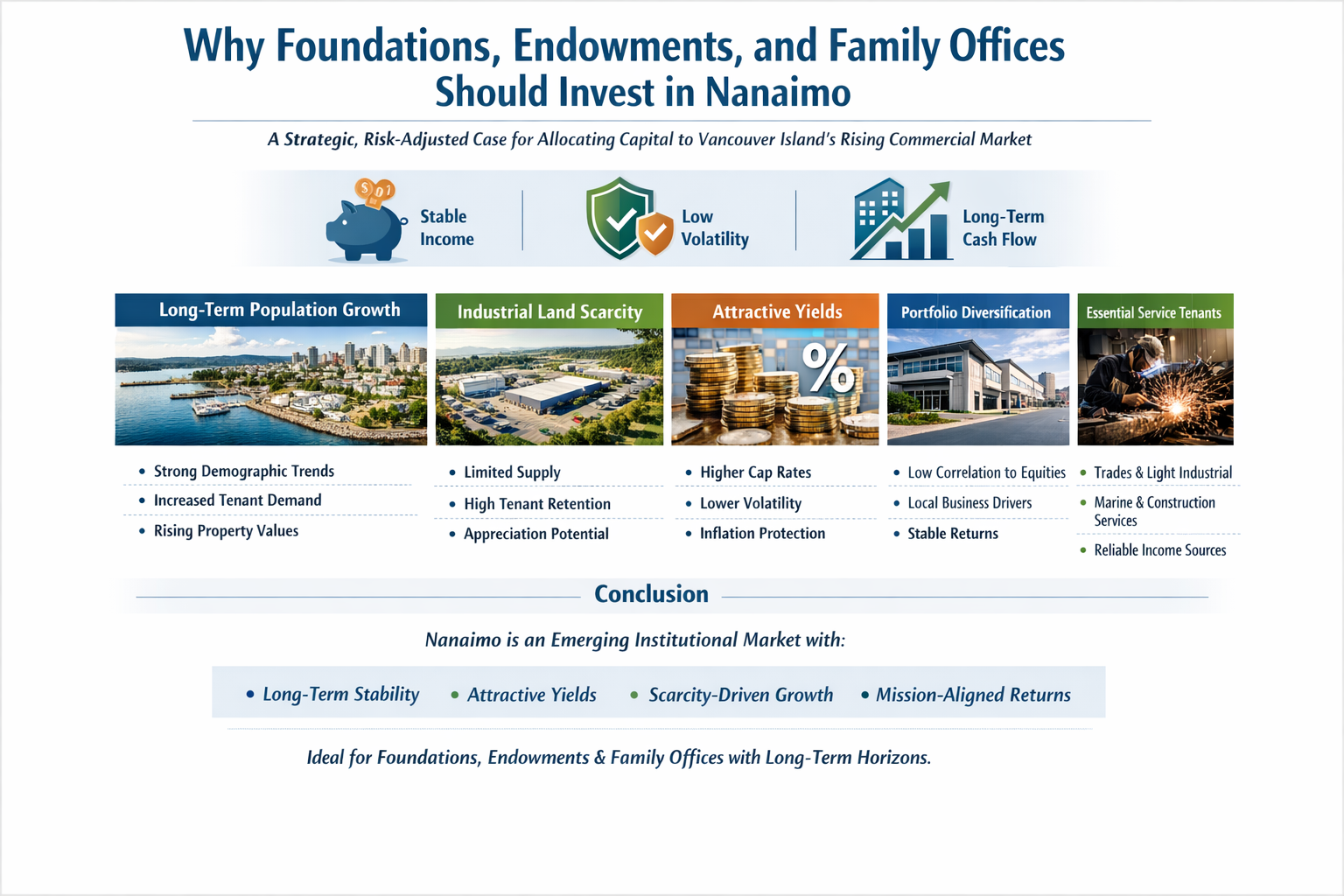
Foundations, endowments, and family offices increasingly seek real estate allocations that offer:
Stable income
Low volatility
Long-duration cash flows
Inflation protection
Diversification away from traditional equities and fixed income
While major Canadian cities receive most of the capital flows, Nanaimo — the commercial and geographic centre of Vancouver Island — has emerged as a structurally strong and strategically advantageous market for institutional and quasi-institutional investors.
This article outlines why mission-aligned investors with long time horizons should consider Nanaimo as part of a disciplined real estate allocation.
1. Long-Term Population Growth Supports Durable Demand
A core principle of endowment and foundation investment mandates is allocating toward regions with demographic tailwinds.
Nanaimo’s population growth profile is one of the strongest among mid-sized cities in Canada, driven by:
Interprovincial migration
Migration from Greater Vancouver
Influx of retirees, professionals, and skilled trades
High quality of life, affordability, and natural amenities
Sustained population growth is a leading indicator of:
Higher commercial absorption
Stronger tenant demand
Improved long-term occupancy stability
Rising land and property values
This demographic momentum aligns well with institutional portfolio objectives emphasizing resilience and predictable long-term performance.
2. Structural Industrial Land Scarcity Protects Long-Term Value
Nanaimo’s industrial and service-commercial land base is constrained by:
Island geography
ALR (Agricultural Land Reserve) restrictions
Limited serviced industrial inventory
Slow municipal rezoning processes
Competition from residential and mixed-use development
This constrained supply creates:
Downside protection
Strong pricing power
High tenant retention
Persistent demand for small-bay industrial
Long-term appreciation support
For long-duration investors — particularly those with perpetual mandates (foundations/endowments) — scarcity is a critical driver of long-term portfolio stability.
3. Attractive Risk-Adjusted Yields vs Major Canadian Markets
Institutions accept lower yields in cities like Vancouver or Toronto due to scale and liquidity.
However, Nanaimo offers superior risk-adjusted returns because:
Cap rates remain 4.75%–6.25% in industrial and service commercial
Lease terms are typically 3–5+ years
Vacancy remains extremely low
Tenant demand is diversified and essential-service oriented
Construction costs and land values remain lower than mainland BC
For a foundation or family office seeking stable, inflation-hedged income, Nanaimo offers a compelling balance of:
Yield
Stability
Appreciation potential
Lower volatility than equity markets
The market is still early in its growth cycle, offering entry pricing that major cities offered 10–15 years ago.
4. Portfolio Diversification & Low Correlation to Public Markets
Real estate serves a stabilizing function in institutional portfolios due to its low correlation to:
Public equities
Fixed income
Alternative assets with higher volatility
Nanaimo’s commercial markets are driven by:
Local business activity
Trades and service industries
Regional demographics
Non-speculative, needs-based tenants
These dynamics create a defensive and predictable return profile, ideal for mission-aligned investors aiming to reduce portfolio volatility.
5. Strong Tenant Fundamentals: Essential Service Demand
Nanaimo’s tenant base is dominated by:
Trades and contractors
Marine services
Construction industry suppliers
Light manufacturing and fabrication
Equipment operators
Automotive and service commercial tenants
These are essential, non-discretionary sectors that remain resilient across economic cycles.
For endowments and foundations aiming to preserve capital while generating stable income, this tenant mix provides:
High occupancy stability
Low turnover
Lower default risk
Minimal exposure to cyclical retail or office volatility
6. Infrastructure Expansion Strengthens the Long-Term Investment Thesis
Institutions invest in markets where infrastructure accelerates economic potential.
Nanaimo is currently benefiting from:
Airport expansion (YCD)
Highway and corridor improvements
Growing port and marine activity
Upgrades to logistics infrastructure
Expansion of commercial hubs in North and South Nanaimo
Growth in higher education and healthcare services
Infrastructure upgrades typically precede sustained commercial absorption — a key reason family offices and endowments allocate early.
7. A Market in the Early Stages of Institutional Maturation
Kelowna and Victoria have already undergone major institutional capitalization cycles.
Nanaimo, however, is just entering its institutionalization phase, offering:
Early-cycle price advantages
Lower competition from institutional buyers
Ability to secure high-quality assets before widespread repricing
First-mover advantages for family offices
In other words, Nanaimo is where Kelowna and Victoria were 10–15 years ago — with fundamentals aligning for long-term growth.
8. Ideal for Long-Term, Mission-Aligned Capital
Foundations, endowments, and family offices typically seek:
Stable cash flow
Modest leverage
Long-term capital preservation
Inflation protection
Low operational complexity
Nanaimo’s industrial and service commercial markets align extremely well with these mandates:
NNN leases reduce operational burden
Industrial tenants are sticky and location-dependent
Land scarcity creates long-term appreciation pressure
Cash flows are predictable and inflation-aligned
This makes Nanaimo highly suitable for perpetual capital structures.
Conclusion
Nanaimo represents one of the most strategically compelling commercial real estate markets in Western Canada for foundations, endowments, and family offices seeking:
Long-duration stability
Attractive yields
Low volatility
Scarcity-driven appreciation
Strong demographic and economic fundamentals
With sustained population growth, industrial land constraints, diversified tenant demand, and improving infrastructure, Nanaimo is positioned to deliver resilient, mission-aligned returns for sophisticated investors with long-term horizons.
Frequently Asked Questions
Why do institutions invest in markets like Nanaimo?
They seek stable income, long-term growth, and diversification away from major urban markets.
What makes Nanaimo suitable for long-term investors?
Population growth, limited land supply, and strong tenant demand support long-term performance.
How does real estate help diversify a portfolio?
It provides income stability and low correlation to equities and fixed income.
What types of properties are most attractive to institutional investors?
Industrial and service-commercial assets with strong tenant demand and long-term leases.
Helpful Resources
👉
