
Avoid Costly Mistakes by Understanding the Approval Process
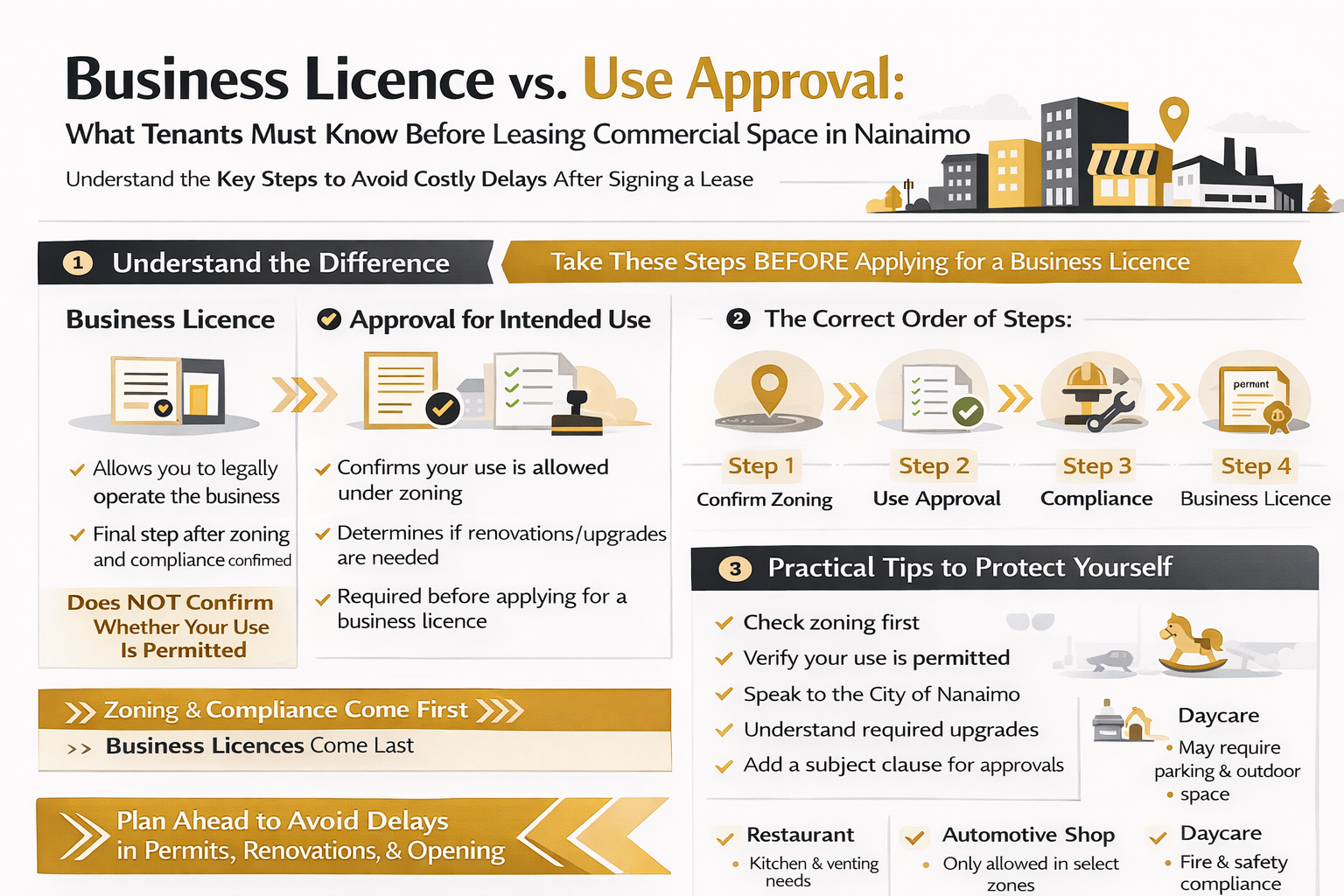
One of the most common misunderstandings in commercial leasing is the difference between a business licence and approval for a specific use of a property.
Many tenants assume that once they secure a lease, they can simply apply for a business licence and begin operations. In reality, municipalities like Nanaimo require that your intended use is permitted under zoning and approved from a planning perspective before a business licence is issued.
Failing to understand this distinction can lead to:
Delays in opening
Unexpected costs
Lease commitments without approval
In some cases, being unable to operate at all
This guide explains the difference and outlines how to approach the process correctly.
1. What Is a Business Licence?
A business licence is a municipal authorization that allows you to legally operate a business within the city.
It confirms:
Your business is registered with the municipality
You meet basic operational and safety requirements
You are authorized to conduct business at a specific location
However, a business licence does not determine whether your use is allowed at that location.
👉 It is the final step, not the first.
2. What Is “Approval for Intended Use”?
Before applying for a business licence, the City must confirm that your intended use complies with zoning and building regulations.
This includes:
Whether your business type is permitted in that zone
Whether it is a permitted use or conditional use
Whether the building meets requirements for that use
This process may involve:
Planning department review
Zoning confirmation
Change of use or occupancy classification
Building permit requirements
👉 This is often referred to informally as:
“Zoning approval”
“Use approval”
“Occupancy compliance”
3. The Correct Order of Steps
Understanding the sequence is critical:
Step 1 — Confirm Zoning & Permitted Use
Is your business allowed in that zone?
Is it permitted or conditional?
Step 2 — Planning / Use Approval
City confirms your use is acceptable
May require additional review or conditions
Step 3 — Building & Code Compliance
Fire safety
Washrooms and accessibility
Ventilation (for restaurants, etc.)
Electrical or mechanical upgrades
Step 4 — Apply for Business Licence
Only after the above are satisfied
4. Real-World Examples (Nanaimo Context)
Example 1 — Daycare
Zoning may allow daycare conditionally
Requires:
Outdoor fenced space
Occupancy classification change
Safety approvals
👉 Business licence will not be issued until these are completed.
Example 2 — Restaurant
Zoning may permit restaurant use
But requires:
Commercial kitchen
Ventilation (hood system)
Fire suppression
Accessible washrooms
👉 Lease signed without checking = major risk
Example 3 — Automotive / Industrial Use
May only be permitted in specific zones (e.g., industrial)
Some commercial zones restrict or prohibit these uses
5. Why This Matters for Tenants
If you skip the approval process:
❌ You may lease a space you cannot use
❌ You may face unexpected renovation costs
❌ You may experience delays of weeks or months
❌ You may breach lease timelines
👉 This is one of the most common and costly mistakes in commercial leasing.
6. Why This Matters for Landlords
Landlords also need to be cautious:
Not all tenants are suitable for every unit
Incorrect use can create:
Compliance issues
Insurance risks
Neighbouring tenant conflicts
A well-informed leasing process:
Reduces vacancy risk
Improves tenant quality
Avoids future disputes
7. How to Protect Yourself (Practical Advice)
Before signing a lease:
✔ Confirm zoning designation
✔ Verify your use is permitted (or conditional)
✔ Speak with the City of Nanaimo planning department
✔ Understand required upgrades or improvements
✔ Include a subject clause for municipal approvals
👉 Example condition:
“Subject to the tenant obtaining all necessary municipal approvals, including zoning, use, and business licence.”
8. The Key Takeaway
A business licence allows you to operate.
But zoning and use approval determine whether you can.
Understanding this distinction is critical to:
Avoid risk
Save time and capital
Ensure a smooth and successful business launch
Conclusion
In Nanaimo’s competitive commercial market, the difference between a smooth opening and a costly delay often comes down to understanding the approval process.
By confirming zoning, securing use approval, and completing necessary compliance steps before applying for a business licence, tenants can move forward with confidence.
For both tenants and landlords, clarity at the outset leads to better outcomes and stronger long-term relationships.
Frequently Asked Questions
Do I need zoning approval before getting a business licence?
Yes, your intended use must comply with zoning regulations before a business licence is issued.
What happens if my business use is not permitted?
You may need to apply for a conditional use approval or find an alternative location.
How long does it take to get a business licence in Nanaimo?
Timelines vary depending on approvals required, but delays often occur if zoning or building compliance is not confirmed early.
Can I sign a lease before getting approvals?
Yes, but it is strongly recommended to include conditions subject to zoning and municipal approvals.
Helpful Resources
👉
👉
👉
👉
