RSS

Vancouver Island vs. Greater Vancouver: Industrial Market Comparison
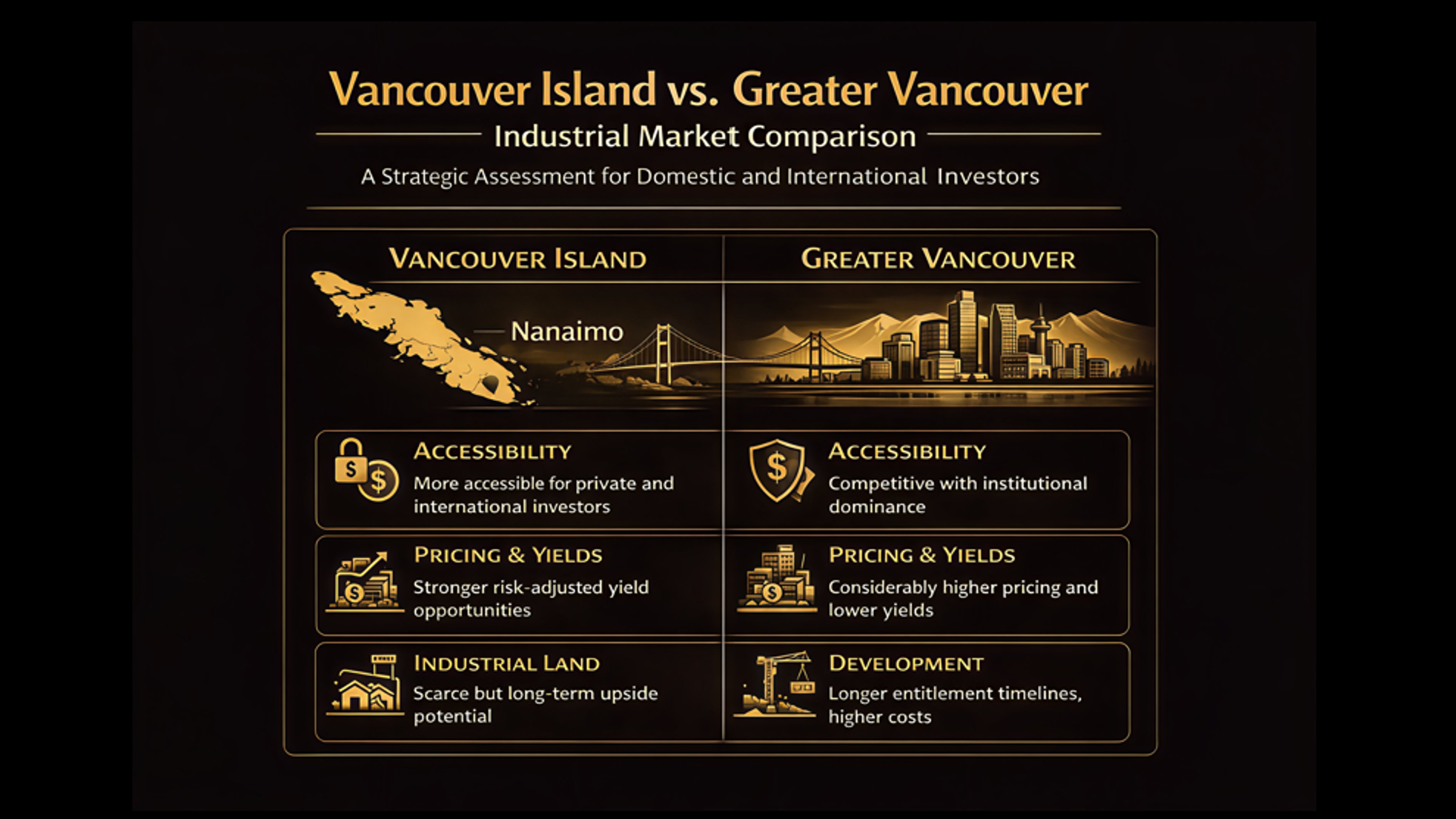
This infographic compares Vancouver Island and Greater Vancouver’s industrial real estate markets, highlighting differences in pricing, cap rates, supply constraints, and tenant demand. While Greater Vancouver offers scale and liquidity, Vancouver Island presents more accessible entry points, stronger yields, and long-term growth potential driven by limited industrial land supply and steady regional demand.

Industrial real estate remains one of the most resilient and sought-after asset classes in Western Canada. While Greater Vancouver is widely viewed as the dominant industrial market in the region, Vancouver Island has quietly emerged as a high-performing, strategically compelling alternative for investors seeking stable yields, resilient demand, and long-term value appreciation.

This comparative analysis outlines the key differences between the two markets from an investment perspective, with a focus on fundamentals, supply dynamics, pricing, and future opportunities.


1. Market Size vs. Market Accessibility

Greater Vancouver

  • One of Canada’s largest and most mature industrial markets

  • Highly competitive with institutional dominance

  • Large-scale assets often traded off-market among REITs, pension funds, and private equity

  • Entry pricing can be prohibitive for many private investors

Vancouver Island

  • Smaller but rapidly growing industrial ecosystem

  • More accessible for private investors (local and international)

  • Attractive opportunities in small-bay strata, service commercial, and land

  • Owner-user demand creates strong price support across cycles

Key Insight:
Greater Vancouver offers scale; Vancouver Island offers accessibility, stability, and lower barriers to entry.


2. Supply and Vacancy: Severe Constraint on Both Sides, But Different Drivers

Greater Vancouver

  • Vacancies near historical lows

  • Structural supply shortage due to limited industrial land and competing residential development

  • High-intensity distribution and logistics demand

  • Extremely tight lease availability, often absorbed before completion

Vancouver Island

  • Similarly low vacancy, driven by trades, construction, marine, and service industries

  • Chronic shortage of small-bay and mid-bay industrial units

  • Limited industrial land due to geography, zoning, and ALR protections

  • High tenant retention due to location-specific operational needs

Key Insight:
Both regions suffer from industrial scarcity, but Vancouver Island’s constraint is long-term structural, supporting resilient pricing and rental growth.


3. Pricing & Yields: Vancouver Island Leads on Risk-Adjusted Returns

Greater Vancouver

  • Among Canada’s highest industrial land and building costs

  • Cap rates often compress below 4.5% for high-quality assets

  • Strong international demand pushes pricing beyond many private investors’ reach

  • Institutional buyers dominate multi-tenant and logistics assets

Vancouver Island

  • More favourable cap rate ranges (4.75%–6.25% in many cases)

  • Lower absolute price points for industrial strata and land

  • Attractive for yield-focused and first-time commercial buyers

  • Less pricing volatility compared to large metro markets

Key Insight:
Investors seeking risk-adjusted yield find more favourable entry points on Vancouver Island without sacrificing tenant demand or occupancy stability.


4. Tenant Profiles: Logistics-Weighted vs. Service-Weighted

Greater Vancouver

  • Heavy concentration of logistics, warehousing, and distribution

  • Demand driven by e-commerce, port activity, and last-mile delivery

  • Large warehouse footprints dominate new supply

Vancouver Island

  • Strong presence of:

    • Trades and contractors

    • Construction-related services

    • Marine and port-support businesses

    • Automotive and equipment operators

    • Specialty manufacturers

  • Tenant demand closely linked to regional population growth and infrastructure expansion

Key Insight:
Vancouver Island’s tenant base is more diversified and less cyclical, providing consistent occupancy even during broader economic transitions.


5. Industrial Land: Scarcity Intensifies the Further You Go from the Mainland

Greater Vancouver

  • Industrial land remains scarce and expensive

  • Competition from residential developers for rezoning

  • High price floors due to institutional interest

  • Limited opportunities for private investors

Vancouver Island

  • Geography restricts expansion of industrial-zoned land

  • ALR and municipal planning reduce supply further

  • Owner-users create strong baseline demand for serviced industrial sites

  • One of the most attractive long-term appreciation plays in BC

Key Insight:
Industrial land scarcity is acute in both markets, but Vancouver Island offers entry pricing and long-term upside that Greater Vancouver cannot match.


6. Development Environment: Faster to Execute, but Still Constrained

Greater Vancouver

  • Longer entitlement timelines

  • Higher development costs

  • More complex municipal processes

  • Labour and material constraints impact construction schedules

Vancouver Island

  • Approvals can be faster in certain municipalities

  • Lower land and construction costs (though rising)

  • Strong demand for build-to-suit industrial and contractor yards

  • Limited competition among developers in the industrial segment

Key Insight:
For investors looking at value-add or development plays, Vancouver Island provides more achievable entry points with strong user demand.


7. Investment Thesis Summary

Greater Vancouver

  • Global gateway market

  • Highly liquid but highly competitive

  • Institutional buyer dominance

  • Lower yields

  • Strong long-term fundamentals

Vancouver Island

  • Strong population and economic growth

  • Limited industrial inventory

  • High tenant retention

  • Attractive yields

  • Lower volatility and easier access for private investors

  • Excellent for industrial land banking and small-bay strategies


Conclusion

While Greater Vancouver remains a powerhouse industrial market, Vancouver Island offers a compelling alternative for both domestic and international investors. With favourable yields, strong demand, chronic land scarcity, and lower barriers to entry, the Island presents a strategic opportunity for investors seeking stability, income, and long-term value appreciation.

For buyers evaluating Western Canadian industrial options, Vancouver Island stands out as a high-quality market with a strong risk-adjusted return profile.


Helpful Resources

👉BC Stats (migration + population)

👉City of Nanaimo Official Community Plan (OCP)

👉 Economic statistics, BC

Read

5 Types of Commercial Real Estate Opportunities on Vancouver Island
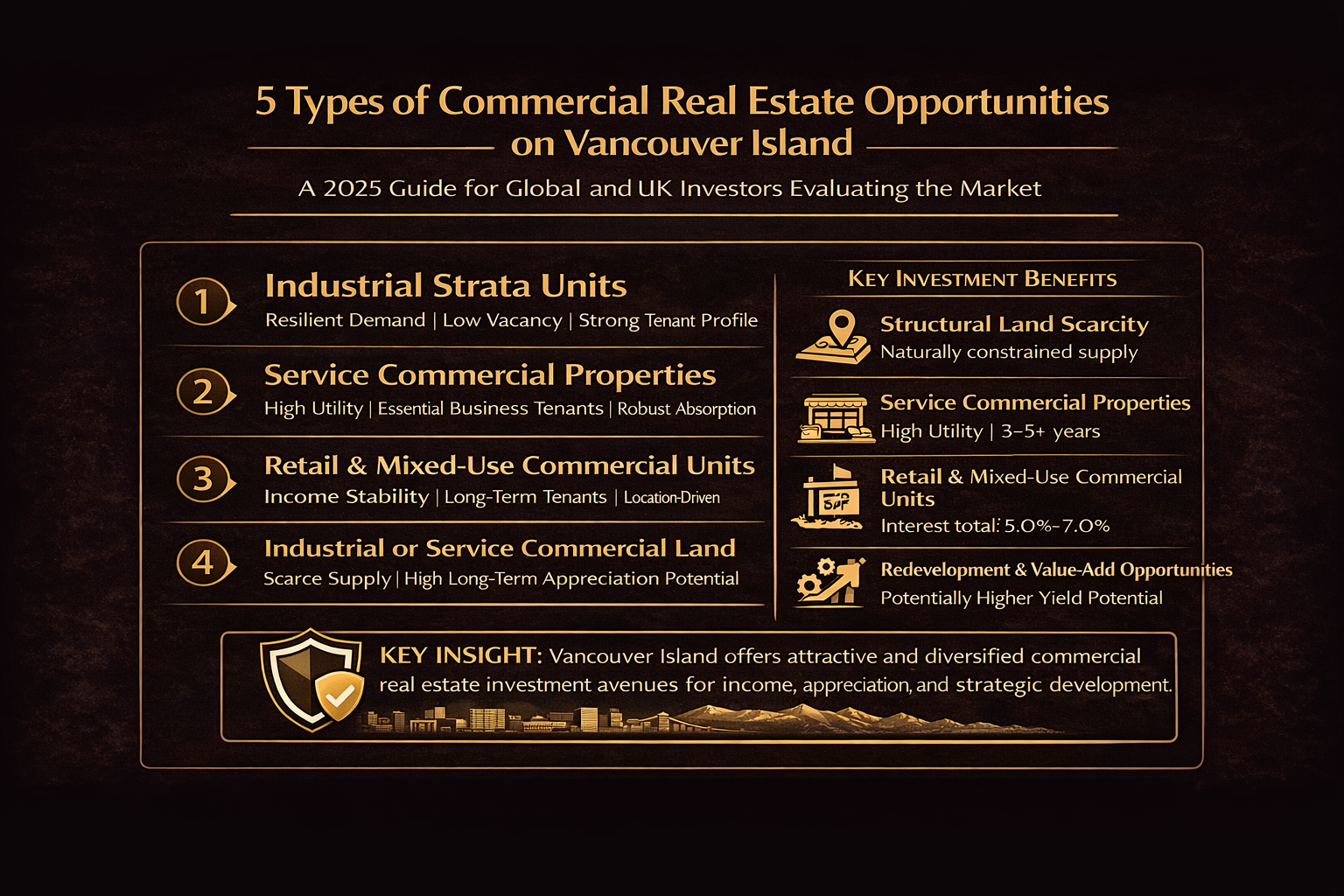
This infographic outlines five key types of commercial real estate opportunities on Vancouver Island, including industrial, retail, office, mixed-use, and land investments. Each asset class offers distinct risk-return profiles, tenant dynamics, and growth potential, helping investors identify opportunities aligned with their strategy and investment objectives.

Vancouver Island has become one of Canada’s most compelling destinations for commercial real estate investment. With sustained population growth, extremely limited industrial supply, and strong tenant demand, the region offers investors a clear path to stable income and long-term capital preservation.

For UK and international investors evaluating opportunities in North America, understanding the types of commercial assets available on Vancouver Island is essential. This guide outlines five key categories, their core characteristics, and the strategic considerations behind each.


1. Industrial Strata Units

Resilient Demand | Low Vacancy | Strong Tenant Profile

Industrial strata units—typically 1,500 to 5,000 sq. ft.—represent one of the most stable and sought-after investment types on Vancouver Island.

Why investors like them:

  • Historically low vacancy, often near 0% in certain submarkets

  • Strong demand from trades, logistics, light manufacturing, storage operators, and service companies

  • Predictable cash flows due to long-term tenants and modest turnover

  • Limited new supply due to zoning constraints

  • Minimal capital expenditures compared to older industrial stock

Typical metrics:

  • CAP rates: 4.75% to 6.0%, depending on age, tenancy, and location

  • Lease terms: 3–5+ years, often with renewal options

  • Tenant improvements: modest compared to office or retail

Who this is ideal for:
Investors seeking stable income, simplicity, and low-maintenance ownership.


2. Service Commercial Properties

High Utility | Essential Business Tenants | Robust Absorption

Service commercial assets include properties used by automotive services, contractors, equipment rental companies, specialty repair shops, and other essential services.

Why they perform well:

  • High tenant retention due to location-specific operational needs

  • Strong absorption driven by growing population and trades industries

  • Often higher yields than newer industrial strata

  • Consistent demand in both economic expansions and slowdowns

Typical metrics:

  • CAP rates: 5.25% to 6.5%

  • Tenant type: Local businesses with stable revenue profiles

  • Lease terms: Often 3–5 years, sometimes longer

Who this is ideal for:
Income investors seeking a higher-yielding alternative to traditional industrial assets.


3. Retail and Mixed-Use Commercial Units

Income Stability | Long-Term Tenants | Location-Driven Performance

Retail strata units and mixed-use commercial spaces (main floor retail with residential above) continue to attract investors looking for balanced yield and tenant diversification.

Key drivers:

  • Long-term tenancy from essential services (food, wellness, personal services, clinics)

  • Steady consumer demand due to strong residential growth on the Island

  • Often located in walkable, central areas with limited new supply

  • Opportunity for investors to underwrite a variety of tenant types

Typical metrics:

  • CAP rates: 5.0%–7.0%, depending on location and covenant

  • Tenants: Restaurants, medical/dental, retail services, boutique operators

  • Capex: Moderate depending on tenant improvements

Who this is ideal for:
Investors comfortable evaluating tenant covenant strength and looking for a mix of income and appreciation.


4. Industrial or Service Commercial Land

Scarce Supply | High Long-Term Appreciation Potential

Industrial land is one of the most constrained asset classes on Vancouver Island. Due to geography, zoning restrictions, and limited greenfield availability, well-located parcels often experience consistent long-term appreciation.

Why it’s attractive:

  • Extremely limited supply relative to demand

  • Useful for land banking, build-to-suit opportunities, or redevelopment

  • Strong appreciation in high-growth areas like Nanaimo and Langford

  • Flexible strategies: hold, develop, or lease as yard space (where permitted)

Typical metrics:

  • Pricing varies significantly by location and zoning

  • Returns driven by appreciation or development strategy

  • Leasing potential for storage, contractors, or equipment yards (subject to zoning)

Who this is ideal for:
Long-term strategic investors focused on appreciation, development potential, or build-to-suit projects.


5. Redevelopment & Value-Add Opportunities

Strategic Upside | Planning-Driven Value | Localized Scarcity

Select properties on Vancouver Island offer value through repositioning, densification, or operational improvements. These opportunities require deeper analysis and execution discipline.

Common strategies:

  • Re-tenanting to improve NOI

  • Enhancing lease structure or term

  • Adding service bays or modifying layouts

  • Pursuing rezoning or redevelopment opportunities

  • Improving property management efficiencies

Why investors consider them:

  • Potentially higher returns than stabilized assets

  • Ability to unlock value not currently reflected in market pricing

  • Strategic fit for investors with development or operational expertise

Who this is ideal for:
Investors with appetite for complexity and medium-term value creation.


Conclusion: A Structurally Strong Market for Long-Term Investors

With its combination of population growth, industrial scarcity, and diversified economic activity, Vancouver Island continues to present well-supported opportunities across multiple commercial asset classes. Whether investing for income, diversification, long-term appreciation, or strategic development, the region’s fundamentals provide a compelling foundation for disciplined capital deployment.

For UK and international investors evaluating global alternatives, Vancouver Island offers a unique blend of stability, transparency, and growth potential.


Read

How to Evaluate a Commercial Property: A Framework for International Investors

A Structured Methodology for Assessing Opportunities on Vancouver Island

This infographic presents a structured framework for evaluating commercial real estate opportunities, covering key factors such as income stability, lease quality, tenant profile, location fundamentals, and risk-adjusted returns. Designed for international investors, it provides a clear approach to underwriting properties and making disciplined, data-driven investment decisions.

Introduction

Evaluating a commercial property — whether industrial, retail, or mixed-use — requires a disciplined and systematic approach. For international investors, the challenge is even greater, as local market context, leasing standards, and underwriting practices may differ substantially from those in the UK, Europe, or other markets.

This article provides a clear, institutional-grade framework to help overseas investors analyse Canadian commercial properties with confidence. While the examples focus on Vancouver Island, the principles apply broadly across the Canadian market.


1. Location & Submarket Fundamentals

Commercial real estate value is rooted in the strength of the underlying submarket. Key considerations include:

Population & Economic Growth

  • Is the region growing?

  • What industries drive the local economy?

  • Are there long-term demographic or migration trends?

Supply and Demand Dynamics

  • How much industrial/commercial inventory exists?

  • Are vacancies stable, rising, or tightening?

  • Is new supply constrained (e.g., zoning, geography)?

Accessibility & Connectivity

  • Proximity to highways, ports, airports, trade corridors

  • Access to labour and customers

Comparable Market Activity

  • Recent sales and lease comparables

  • Trends in rental growth

  • Cap rate movement

On Vancouver Island, markets like Nanaimo and Langford stand out due to high population growth, limited industrial land, and robust tenant absorption.


2. Tenant Quality and Covenant Strength

Tenant stability is fundamental to income durability.

Key factors to assess:

  • Business type and industry resilience

  • Years in operation

  • Financial strength (if available)

  • Alignment between the tenant’s business model and the unit’s location/features

  • Probability of renewal

  • Dependence on the specific space (e.g., automotive bays, contractor yards, specialized layout)

High-covenant tenants support predictable income and lower vacancy risk.
In contrast, specialized uses or weak businesses require more conservative underwriting.


3. Lease Structure, Terms, and Cash Flow Visibility

A commercial property’s value is directly linked to its lease agreements.

Critical lease components to review:

Term & Remaining Duration

  • Length of remaining term

  • Renewal options (and whether they are at market or fixed rates)

Rent Structure

  • Base rent

  • Additional rent (NNN, CAM, operating costs)

  • Escalations (annual %, fixed increases, CPI-based)

Responsibility Allocation

  • Who pays for:

    • Property taxes

    • Insurance

    • Maintenance

    • Repairs

    • Capital expenditures

Special Clauses

  • Termination rights

  • Exclusive use provisions

  • Options to expand or contract

  • Rights of first refusal (ROFR) or first offer (ROFO)

A strong lease structure increases income visibility and enhances property value.


4. Physical Asset Assessment

The physical characteristics of the property influence its long-term viability and maintenance obligations.

Considerations include:

  • Building age and condition

  • Structural integrity (roof, foundation)

  • HVAC, electrical, plumbing

  • Ceiling height, loading, bay size (for industrial)

  • Parking, access, and visibility (for retail or service commercial)

  • Zoning compliance and permitted uses

  • Potential environmental risks (Phase I ESA may be required)

A professional inspection provides clarity on deferred maintenance and upcoming capital expenditures.


5. Financial Underwriting & Sensitivity Analysis

Institutional investors rely on disciplined underwriting to evaluate returns.

Core components to model:

Net Operating Income (NOI)

Calculation:
NOI = Gross Rent – Operating Expenses

Cap Rate Analysis

  • Compare to market ranges

  • Adjust for asset age, location, and tenant profile

Internal Rate of Return (IRR)

IRR modeling helps assess multi-year return potential, especially with:

  • Rent escalations

  • Lease expiries

  • Capital projects

  • Re-tenanting scenarios

Sensitivity Scenarios

Evaluate impacts of:

  • Higher vacancy

  • Lower rent growth

  • Increased cap rates

  • Unexpected downtime

These stress tests ensure resilience under conservative assumptions.


6. Zoning, Regulation, and Permitted Uses

Understanding local zoning is essential — especially on Vancouver Island, where industrial land is scarce.

Key questions:

  • Does the property’s zoning align with current use?

  • Are future uses permitted under existing zoning?

  • Are there restrictions on:

    • Outdoor storage

    • Automotive uses

    • Contractor yards

    • Retail/service uses

Having clarity here prevents operational or leasing challenges in the future.


7. Exit Strategy and Long-Term Value Drivers

Before acquiring a property, investors should evaluate the asset’s potential exit pathways.

Possible exit strategies:

  • Hold and collect income

  • Sell to owner-users (often pay a premium for industrial)

  • Reposition or re-tenant

  • Subdivide (where permitted)

  • Redevelop (zoning dependent)

Value drivers to consider:

  • Population and economic growth

  • Zoning changes or densification plans

  • Infrastructure improvements

  • Tenant demand trends

  • Competing land uses

Assets in constrained markets (such as industrial on Vancouver Island) often outperform due to scarcity and strong user demand.


Conclusion

A disciplined, structured framework is essential for evaluating commercial real estate — particularly for international investors unfamiliar with Canadian leasing norms and market dynamics. By assessing location, tenant quality, lease structure, physical condition, financial performance, zoning, and exit potential, investors can make informed, defensible decisions.

On Vancouver Island, the combination of long-term population growth, limited industrial inventory, and resilient tenant demand creates a market environment well-suited for investors seeking stability and strong risk-adjusted returns.


Read
MLS® property information is provided under copyright© by the Vancouver Island Real Estate Board and Victoria Real Estate Board. The information is from sources deemed reliable, but should not be relied upon without independent verification.